
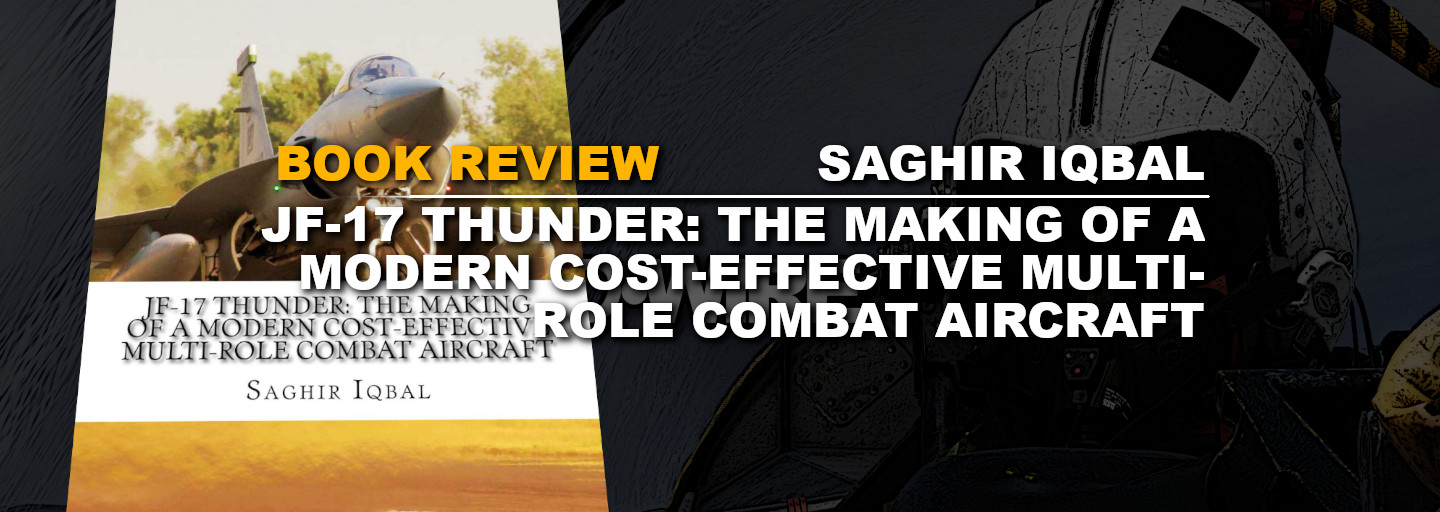

Saghir Iqbal is a researcher in International Relations and Security Studies. He is an experienced Intelligence Analyst and has achieved a number of qualifications in this field. He is also a Lecturer in Business Management as well as an Examiner for A Level History and Business. Complete bio.
Book details
Author: Iqbal, Saghir
Publisher: Independent
Publication date: 26/02/2018
Formats: Paperback, Kindle
Print pages: 178
Medium reviewed: Kindle
Review date: 31/12/2024
Introduction
The JF-17 “Thunder” is a fighter jet developed at the end of the last millennium and delivered in the late 2000s. Born as an affordable, modern, multi-mission aeroplane, the Thunder was specifically designed to replace the ageing Pakistani Air Force fleet of Chinese-equivalent MiGs, French Mirage and others.
Meant to work in conjunction with the PAC most modern aircraft, the F-16C block 52, the JF-17 follows a different path. The Thunder is a Sino-Pakistani project to minimise the impact of American sanctions and create a product suitable for export. Russian experts offered additional input, especially regarding its engine: the Klimov RD-93, the same engine powering the MiG-29.
The book by Saghir Iqbal covers the project’s history, raison d’être, capabilities, ordnance, and plans for future expansions and upgrades, such as adopting AESA radar in the JF-17 block 3, “man-in-the-loop” missile guidance, JHMCS-equivalent helmet devices and more.
Positive notes
- Few books cover the history and characteristics of this interesting aeroplane. Although it was publicly presented for the first time in 2010 at Farnborough (UK), it is barely known in the West. The public may have heard of the JF-17 due to the PAC operations in Afghanistan, the most recent being in December 2024, shortly before this writing. Aviation fans and gamers may have heard about it thanks to DCS and other games such as War Thunder, but it is not as a popular name as many other Soviet-Russian or Chinese aircraft. Ergo, the existence of books such as this helps to spread knowledge to enthusiasts and not.
- The book contains a considerable amount of images, sketches, and tables. Besides the decorative purpose, images help to understand peculiar characteristics, such as the development of DSI, or “diverterless supersonic inlet” design, the positioning of ordnance stations and missiles and fuel tanks combinations, and so on.
Other Observations
- The mentioned images are collected from several sources, from DeviantArt to Pakistani and Chinese Air Forces-made content, The Time and others. Therefore, if you are looking primarily for media, then searching the internet can provide some common results.
- The book contains a non-ignorable amount of repetitions. Several paragraphs are reported in multiple points of the book. Checking on Amazon, the same book is available split into chapters. From this perspective, the repetitions make sense, but they do not in the context of a single, complete book.
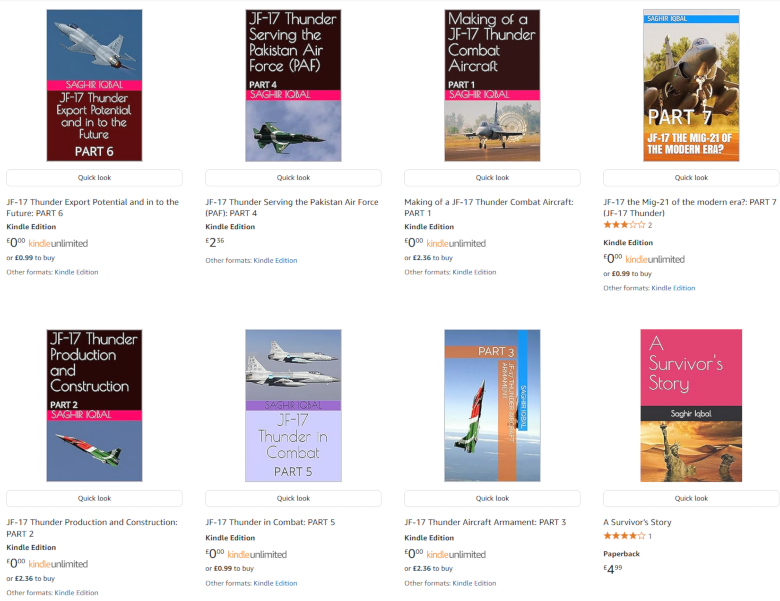
- Once repetitions and images are taken into account, the book is relatively short. The fact that the Jf-17’s operational history was very limited in 2018 probably affects this, as the author had restricted operational missions and reports to discuss and analyse.
- The book lacks particulars not already publicly available. Many details are reported on sites such as jf-17.com or even DCS JF-17’ full manual. As a sidenote, if you are looking for a translation of such a manual, currently available only in Chinese, head to the Download page.
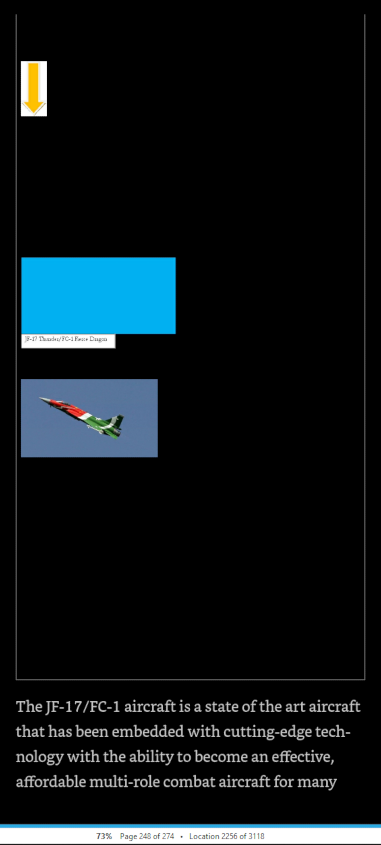
- Although I love physical books, they are not easy to read in the middle of the night, so my de facto forced choice is a Kindle. Books ported to this medium are sometimes poorly optimised. The images in this book have no issues, but unfortunately, the diagrams are entirely off, see the example below.
Conclusions
This book is a nice addition for readers new to the Pakistani Air Force, its fighter jets inventory, and the choices that seem to be driving it away from the US hardware.
If you are already familiar with these topics and the development and characteristics of the JF-17 Thunder itself, its values decrease, in my opinion.
The chapter about the JF 17 goes moderately in-depth on some design choices and capabilities, but it lacks a complete technical discussion. The general public surely welcomes this aspect, but enthusiasts probably prefer more data.
At the moment of writing, the book is almost seven years old. Given how new the JF-17 is, the author had little information to share from actual missions and debriefings. Since the Thunder has been used in recent operations, a future second edition of this book may be even more interesting if such operations are discussed. Like many enthusiasts, I would love to know more about the missions, the lessons learnt and the tactics used by this aeroplane.
 FlyAndWire