

This article is based on a script that I wrote for a video on this subject, but I think some points made in the introduction of that video are worth making again here.
I was motivated to make the video at least partly in response to Heatblur announcing that they would be providing a “bombing computer” with the F-4E to allow you to compute any combination of dive angle, speed and sight depression in real time in the cockpit.
This sounds impressive. I don’t think it will be very useful though. I realize that I may be almost alone in feeling that way. But it is based on my experience in DCS and also my reading of the tea-leaves of what is going to happen when the F-4E is released.
There has been lots of hype about the F-4E. Which means that there are some pretty high expectations as well. One major feature of the F-4 that may be under appreciated in the general DCS population – is that the F-4 will be a major step backward in terms of aircraft design and technology compared to the jets that most players fly – like the F-18 and the F-16.
I do not mean that the plane itself will be inferior. By all accounts It promises to be a very detailed and sophisticated digital model – but the aircraft it models is not as sophisticated an aircraft as the modern jets. It belongs to a very different age. An age that is characterized by significantly less capable electronics, but also an age when expectations where different and one in which pilots came to the cockpit with very different backgrounds than modern pilots. Remember, the first pilots to fly the F-4E were born in about 1950 at the latest. They did not grow up in front of keyboards and screens.
This may require some adjustment if you are a “digital native” and are used to flying the newer 4th generation machines in DCS.
One of the big changes is going to be that the F-4 will not have a HUD that is as sophisticated as you are used to. It will be far less integrated with other aircraft systems (because the capacity to communicate data from one piece of avionics to another was genuinely in it’s infancy at the time).
Which means that you will almost certainly NOT have a CCIP pipper on your screen in the F-4E. If you haven’t spent a lot of time dropping iron bombs without the aid of a CCIP pipper you might be unpleasantly surprised with just how hard it is to hit what you are aiming at without that assistance.
One of the reasons for this, I think, is that most of us come at this this backwards in DCS. We start with modern technology and then work backwards to the old ways. Real pilots do it the other way around. The reason that’s an issue in this particular case is because CCIPs major advantage is that it allows you to drop bombs without needing a very good plan for how to do it. Furthermore, if you mess up the approach and roll in, the presence of that pipper on your screen allows you to correct your mistakes and still hit the target.
All of which means that you don’t really need good technique to hit the target when you are using CCIP. But this means you can tend to develop bad habits because you do not pay the price for not having developed good ones. Those same habits may not serve you well when you go back in time to earlier aircraft – like the F-4 – where planning and technique matter.
Now, as I said, real pilots, on the other hand, start from the basics and learn technique – by which I mean good habits – in the absence of the aid of the pipper. This forces them to be consistent because the whole point of good technique is to develop consistency. If every bomb run feels the same, then you start making adjustments by “feel” instead of by reading the numbers or even instead of focussing all of your attention on the circle, dot, or cross in the middle of your screen.
This is critical because when you start having to use these skills in a high stress environment, that “muscle memory” is going to be what you need. In a situation where someone is trying to kill you – even virtually – you won’t have the bandwidth to fly by the numbers.
What is more, you really don’t need to.
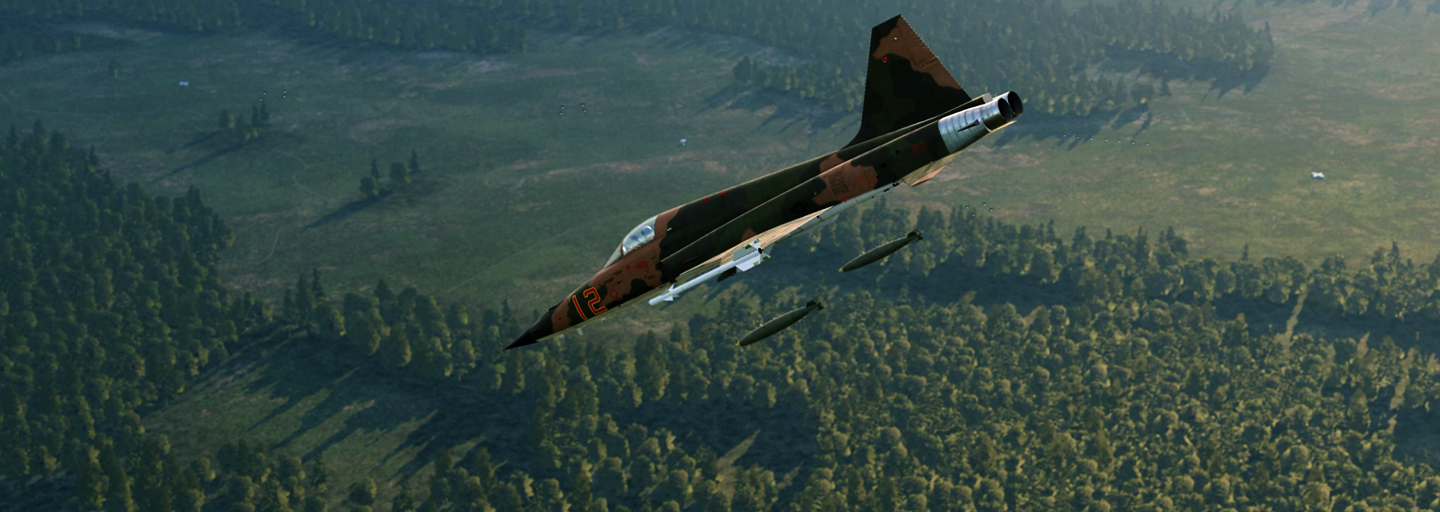
In the video, I go out to the range with the simplest iron bomber I could find – the F-5E – to show it is possible, in the game, to derive the bombing table numbers even in this simple cockpit. But, honestly, that wasn’t really the point.
The point WAS to demonstrate first of all that you do not need, and for my money, should not use, published bombing tables as anything more than a starting point. The second point was to show that the value of deriving your own numbers does not come from finding them and writing them down. The value of doing it from the cockpit is that we also learn how it looks and feels – IN THE GAME – when we get it right.
If there is one thing I believe about being deadly with dumb bombs in DCS, it is that getting proficient is NOT about memorizing numbers. It IS about identifying and memorizing the cockpit cues that work for you at the moment of release. This is mostly about the sight picture – i.e., what we see on the HUD. But it is also about the sound – and also, to some extent, the mental picture of the analog instruments. By that, I mean the positions of the needles – not the numbers they point at. All of this happens in our peripheral vision. All of this depends, to some extent, on how you play DCS – VR or not, headphones or not, etc. You simply can not get good at this by reading a textbook (or an article like this one – HAH!).
You have to practice because doing this well requires that “muscle memory”. And it can only be developed by doing the same thing the same way many, many times. So first, we have to figure out what to do – to get the result we want – then we have to learn it by doing it over and over again.
This means, by the way, that you need to find a way to practice where you can evaluate your progress. You can’t just hit some random target once and decide you have got the problem solved. You have to find a way of comparing from run to run and deciding what works better.
That’s why I use my range mission and the Target Impact Tracking Script written by Draken. It gives precise and objective feedback that helps me decide if I am actually succeeding – and to analyze what is changing when I am not.
I am sure there are other ways of solving the problem. And I know for sure that there are players out there who are better at this task than I am. But I don’t know anyone who got good at it (I mean really, reliably, demonstrably GOOD at it) by looking at a page full of numbers. You can start there, but eventually, if you want to improve, you need to find a place where you can practice and where you can learn what works for you, regardless of what anyone else says.
 FlyAndWire
” They did not grow up in front of keyboards and screens. “. haha, I bet half your audience is struggling to understand what that really means. Good luck to them. All good points though. If Heatblur’s F-4E flies at all like the popular “modern” DCS jets they will have failed. I suspect a lot of people are going to be humbled by the experience. For those that stick with it (and learn the fundamentals) it is going to be very satisfying coming to grips with the module.
LikeLike