


This is where a viewer, Chess, came in with observations and tests highlighting units’ behaviour and inconsistencies. So, without further delay, here are his findings.
Anti-aircraft Artillery (AAA) in DCS is composed of various guidance units and gun platforms; these assets are a mix of static and self-propelled systems, spanning from modern to WWII-era equipment. Most of the WWII-era AAA guns are part of the purchasable WWII Asset Pack module.
When employing AAA in DCS missions, several inconsistencies and unexpected behaviors (or anomalies) can be encountered. These issues can significantly influence the player’s experience when engaging with these systems. The lack of clear, detailed documentation regarding the use of these units and the impact of variables—such as skill level, the number of guns in a group, or the presence of a guidance unit—may partly explain the relatively low adoption of AAA systems in user-created missions.
In an effort to determine the optimal use of these units in DCS and to understand why their adoption remains relatively low in user-created missions, thorough testing was conducted, which revealed the following key findings:
- For AAA guns under 57mm caliber, the addition of a guidance unit does not appear to influence the gun’s accuracy or range, suggesting the guns do not utilize the guidance data.
- For AAA guns at and above 57mm caliber, the addition of a guidance unit visibly impacts gun behavior. Specifically, the guns will activate and sometimes begin engaging targets earlier than their unguided counterparts.
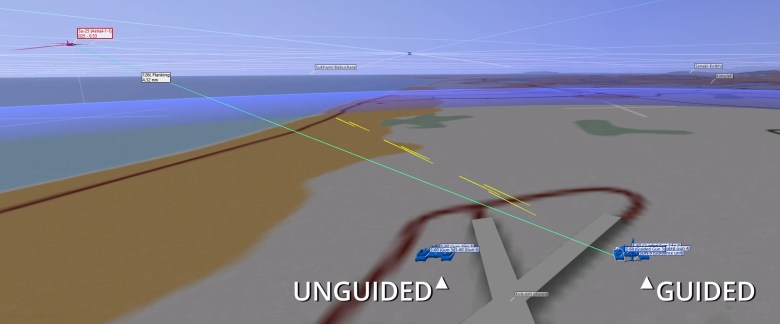
P2 – Guided guns fire earlier. - A given gun platform can only be guided by its corresponding guidance unit. (e.g., Kdo.G for German FLAK guns, Allied Rangefinder for QF 3.7, SON-9 for S-60 and KS-19). Adding a different guidance unit to the group causes the guns to revert to unguided behavior.
- Adding an Early Warning Radar (EWR) to the group does not appear to provide Early Warning (EW) data to the guns, which continue to exhibit unguided behavior.
- The position of the guidance unit within the AAA group does not appear to have any impact on the group’s performance.
- Adding more than one guidance unit to the group does not appear to have any impact on the group’s performance.
- A given AAA type has a simultaneous fire limit. (e.g., the KS-19 and FLAK 18 can fire up to six guns simultaneously, while the S-60 and Bofors 40mm can only fire four). Any surplus gun units will remain inactive until an active gun ceases fire or runs out of ammunition.
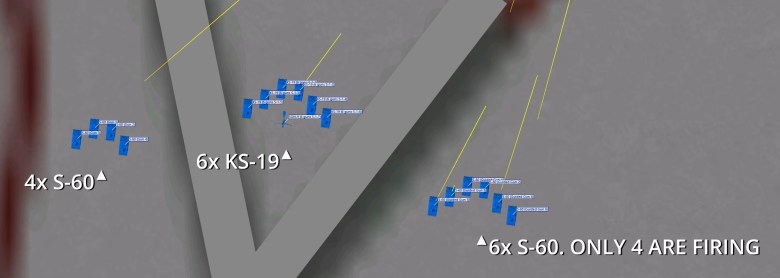
P7 – Number of guns firing is limited. - AAA of all calibers in DCS appears to fire only time-fuzed ammunition. While this is accurate for some calibers and gun types, the omission of proximity-fuzed ammunition for most guns significantly reduces their intended lethality.
- A significant anomaly can be observed when guidance is added to a group. A practical example is necessary to fully understand this behavior.
For example, consider a radar-guided AAA group consisting of a SON-9 “Fire Can” radar and S-60 guns. The radar is offset approximately 150m to the west of the guns.
As the target approaches, the AAA battery suddenly shifts fire onto a parallel course, thus stopping compensating for the offset. The expected gun behaviour would be adjusting for the 150m difference by pointing a few degrees towards the target. Since this does not happen, the battery persists firing following a parallel heading toward the empty sky.
This is detrimental; even with guns placed in close proximity to the radar, the aiming error persists. This flaw, in combination with the lack of proximity fuses, paradoxically leads to lower effective accuracy when the guns are guided compared to when they are unguided.
The identified inconsistencies, particularly the caliber-dependent guidance application and the systematic aiming offset when units are paired with their corresponding radars, suggest several opportunities for model refinement. Rectifying these issues, alongside the crucial addition of proximity-fuzed ammunition, would not only drastically improve the fidelity of high-caliber AAA but would also encourage the wider, more reliable adoption of these systems by mission designers in the DCS environment.
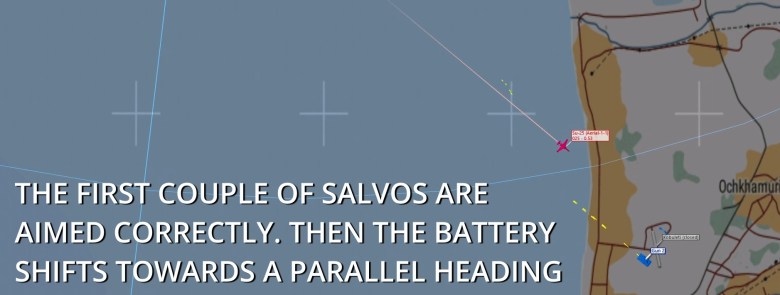
P9 – Guns firing parallel to the target.
 FlyAndWire