

Video
Moreover, the Pulse-only APQ-120 suffers from the constant issues of clutter and limited detection range thus requiring a non-indifferent amount of work and attention by the WSO.
Azimuth and Range
Starting with the azimuth settings, only two options are available: wide and narrow.
This table shows the common search radar modes of fighters introduced around the same period of the F-4E and available in DCS, plus modern aeroplane examples, along with general detection ranges for fighter-sized aircraft using search modes.
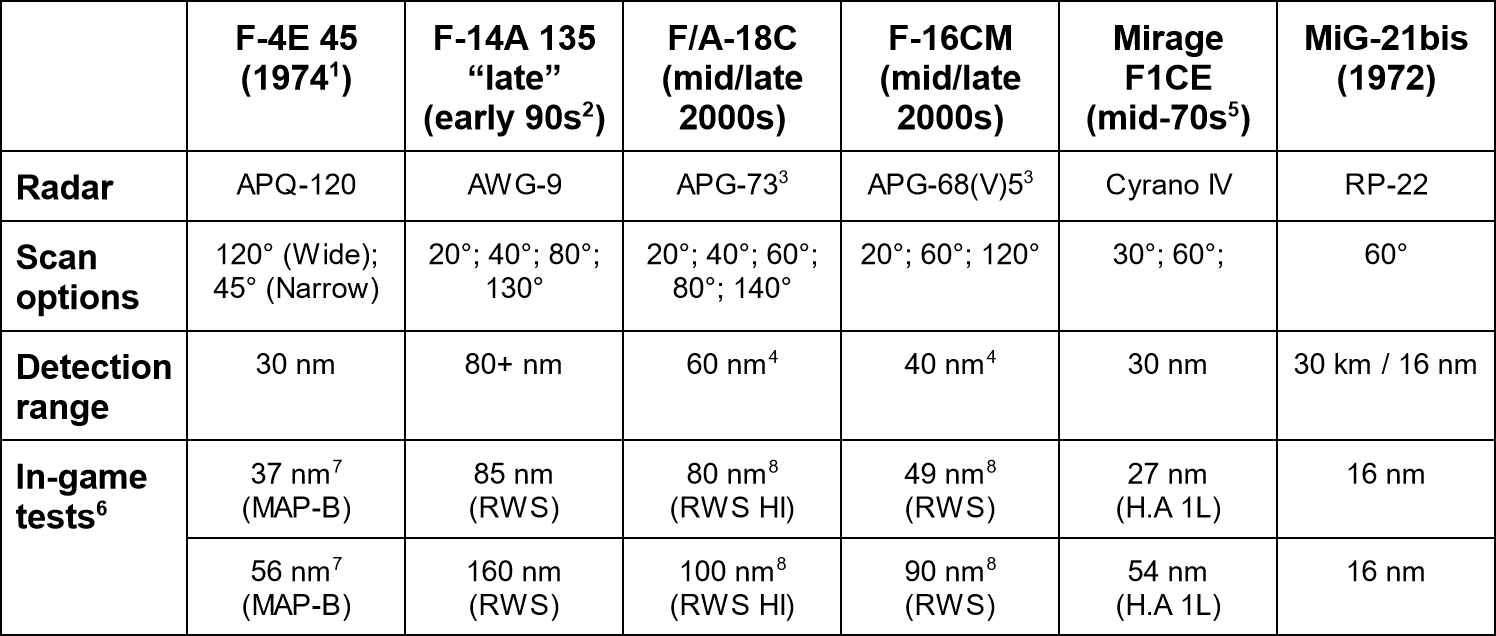
1- The first F-4E variants were introduced in the late 60s. The mid-70s -45 includes DSCG, slats, AGM-65.
2- Similar to late 70s variants besides AN/ALR-67 and LANTIRN pod added in the 80s and 90s.
3- Both radars were introduced between the late-80s (APG-68) and the early/mid-90s (APG-73).
4- Depends on the probability of detection.
5- In Spanish service.
6- First test: bogey MiG-23 0TA-180AA / 0ATA, co-alt, clean. The second test had the same geometry, bogey Tu-22M3.
7- This value may change in the future as the module is polished and completed.
8- First continuous detection.
When the APQ-120 is operated in the Narrow mode, the horizontal orientation of the radar antenna is controlled via the Antenna Hand Control.
These sketches visualise the differences between the wide search settings of different aircraft.
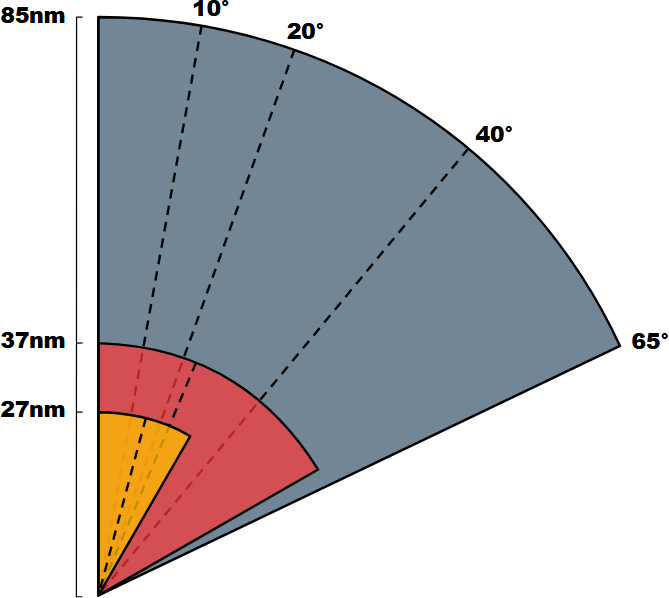
GREY – AWG-9; RED – APQ-120; YELLOW – Cyrano IV
Range-wise, instead, the differences are not only a consequence of the power output but also greatly depend on the radar mode in use. For instance, the AWG-9 can detect a contact at circa 60 nm in Pulse Search, but the range doubles in Pulse Doppler Search. Besides the Tomcat, the F-4E is in line with other aircraft of the 70s currently available in DCS.
Additional settings influence the detection range and quality, such as the Pulse length, controlled via a 3-way latched switch and offering Long, Short, and Auto options. At long-range settings, beyond AI, Long Pulse is commanded, featuring a narrower band. It is a compromise between power, better long-range detection, electronic countermeasures and noise susceptibility. “Short” may provide cleaner images within 15 nautical miles.
Elevation
The APQ-120 provides only two “bars” options: 1 bar and 2 bars. However, it is more complicated than that, and the selected radar mode also influences the volume of airspace scanned. In “Radar-B” mode, the antenna is nutating, thus following a peculiar pattern covering 6.7°. The alternative is the “Map-B” mode, which does not feature the antenna nutation. In real life, the latter mode is recommended to prolong the life of the radar.
There are three possible combinations affecting the scanned volume, since Map-B with 2 Bars is not available.
| 1B | 2B | |
| MAP-B | 3.7° | N/A |
| RDR-B | 6.7° | 10.45° |

Compared to radar systems capable of providing multiple scan bar options, the volume of airspace covered by the APQ-120 is surprisingly tall. The following is the late 60s AWG-9.
| AWG-9 | 1B | 2B | 4B | 8B |
| Height | 2.3° | 3.6° | 6.3° | 11.5° |
Although these options provide great flexibility on paper, in reality, scanning 2 bars can have adverse effects, such as making discerning a contact more difficult. For example, actual contacts are often immediately recognisable by their persistence on the radar scope, whereas clutter artefacts may change and disappear after each sweep. Intuitively, alternating bars make this process more complicated. Moreover, taller volumes make excluding clutter more difficult.
Both Map-B and Radar-B offer the 1-bar option. The nutating pattern almost doubles the height of the scanned volume. In real life, the MAP mode should be used to reduce the mechanical stress of the feed horn, but in-game, this solution primarily has the advantage of increasing the precision of the detection, which often translates into range and, therefore, directly affects situational awareness.
On the other hand, there are occasions when taller options may be used, such as when feet-wet, when the radars of a section are mated to maintain radar awareness on already known targets or at closer range before sort and meld. If sheer detection range is the objective instead, using Map-B seems to be the preferable choice.

Parenthesis: STT, Boresight and CAA
The radar modes discussed so far are the typical “search” modes. Single Target Tracking, boresight and Computer Automatic Acquisition are peculiar modes and use different combinations of azimuth, range and elevation.
STT, as the name implies, focuses the radar on a single target, which is automatically tracked in azimuth, range and elevation.
Boresight locks the radar “on the nose” at 0 ATA and at a range of 5 nautical miles.
Lastly, CAA offers a complex short-range mode where the airspace is divided into three parallel scan areas. This mode has been discussed in greater detail in the Phantom Phamiliarisation series.
 FlyAndWire