

Unplanned initially, I later expanded the discussion about the Sync-Z-Turn to show how its fundament concepts can be applied (sometimes forcibly and with several adjustments) to other modules:
- Sync-Z-Turn: Explanation (F-4E)
- Mirage F1;
- F-14 Tomcat;
- F-5E-3 Tiger II;
- MiG-21bis;
- MiG-29 Fulcrum.
Video
A couple of days ago, I released an article about the “Sync-Z-Turn” manoeuvre, an immediate and effective means of positioning the fighter no matter the light and weather conditions, presence of jammers or lack of information.
In this article, I recorded the same manoeuvre using a Mirage F1. This is the first time I spent more than a couple of minutes into this brilliant single-seater fighter jet, and this fact reinforces how neat the Sync-Z-Turn is.
Senario & Execution
A Jordanian Mirage F1 is tasked to VID a group of bogeys flying at 10,000 feet. The pilot, yours truly, is rushing following heading 295, a general indication provided by the GCI.
Since I already knew the altitude and the radar’s performance, I switched to 35 nm, 1 bar.
This set of info is not necessary, but it’s nice to have a bit of background for a change. However, a certain degree of initial information is necessary if the fighter’s radar performance when searching is poor, such as the APQ-120 or the Cyrano IV.
The procedure works as described in the article mentioned before. Proceed until radar awareness, put the contact on the nose and evaluate the drift. Then, move the contacts to the cold side of the display at a synched ATA value until the AoB is greater than circa 30°. Finally, turn to pure and eventually go wings-level behind the targets.
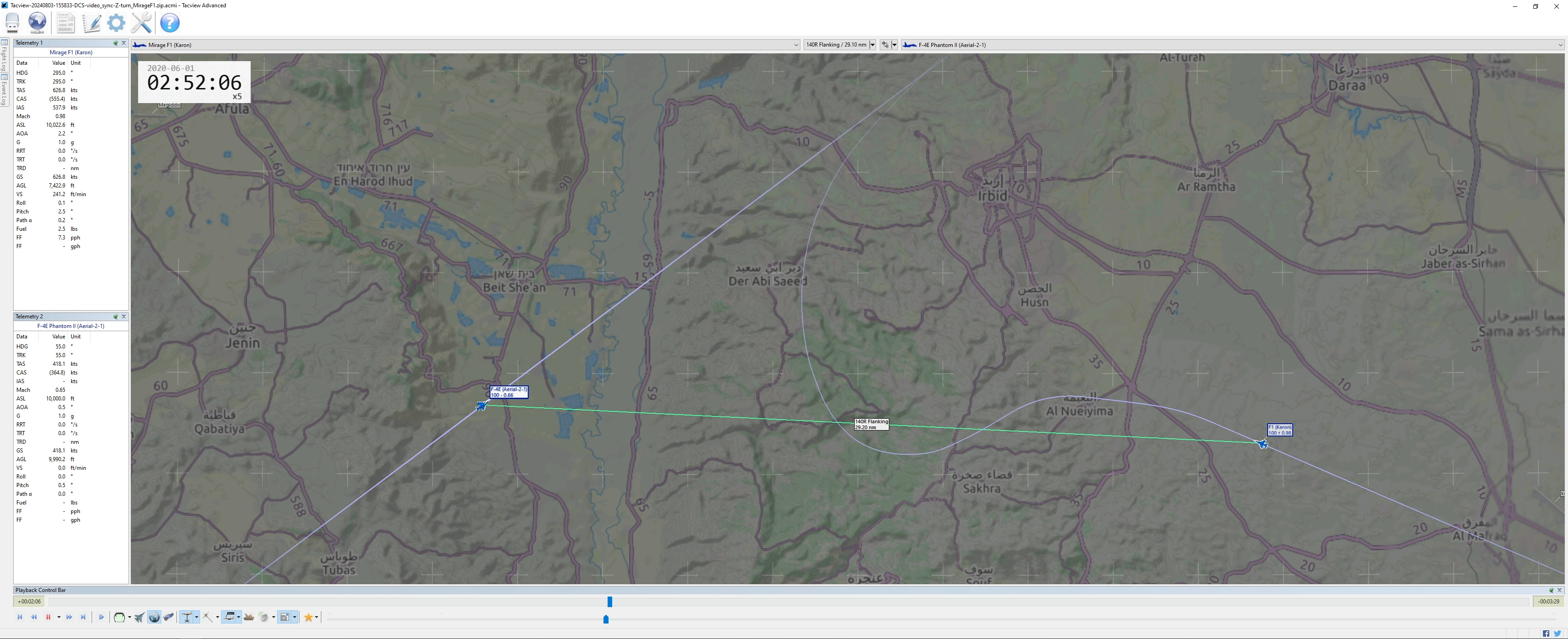
The beauty of the Sync-Z-Turn is that it works in a plethora of situations. In this case, the bogeys appeared on the radar scope at circa 26-27 nm. By the time I put them on the nose and assessed the drift, the range was down to 20 nm. Such a short range does not leave a lot of time to think, so I immediately placed the contacts close to the gimbal limits and monitored the AoB. Soon after, it was already time to put the contacts on the nose!
To put things into perspective, the F-4E’s APQ-120 usually provides a greater detection range, so all the preliminary steps can be completed before the 30 nm threshold.
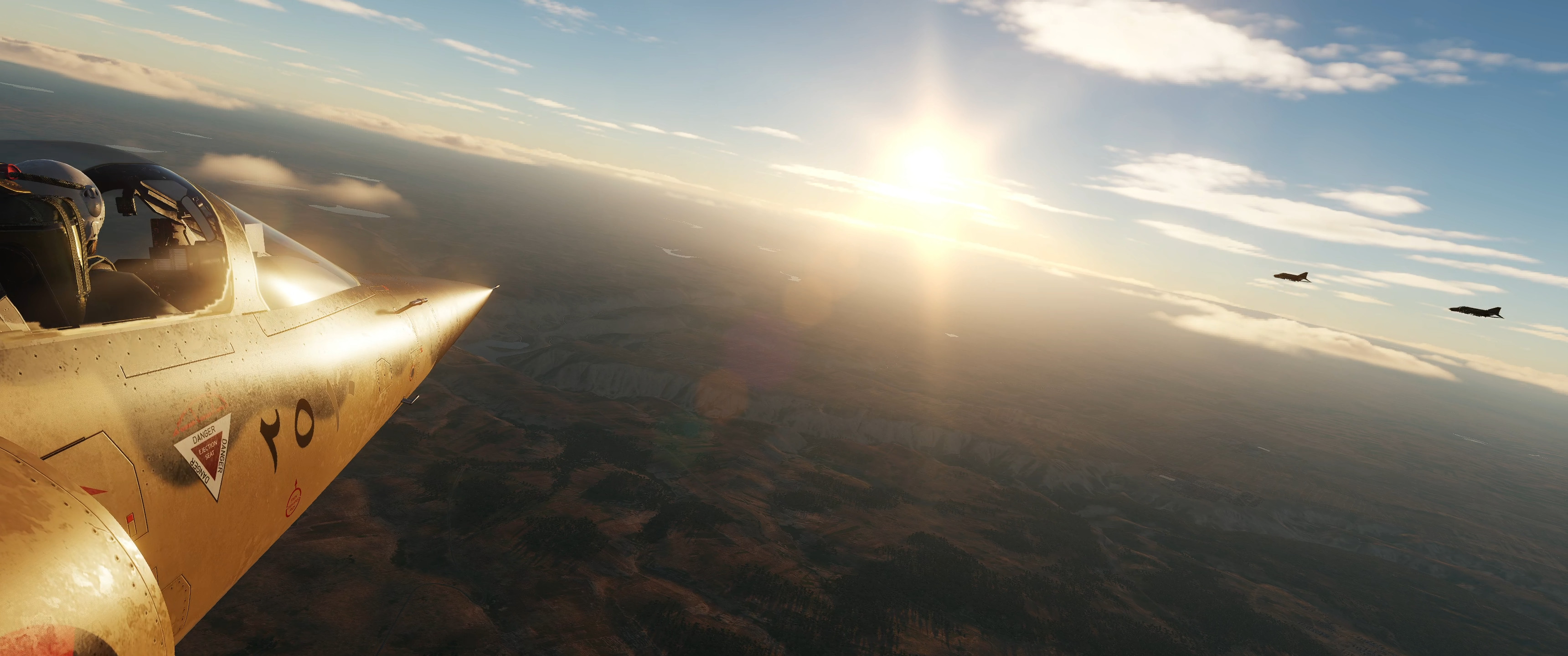
Eventually, VID is completed: here is a section of smokey and beautiful Israeli sledgehammers.
TacView Analysis
The always fantastic TacView provides a better view of the flow. As mentioned, I am definitely not a good pilot and I have never used the Mirage F1 for tests longer than this intercept, but I “kind-of-still-managed” to get there. With some practice and experience, this manoeuvre can be successfully executed with fantastic results.
 FlyAndWire