
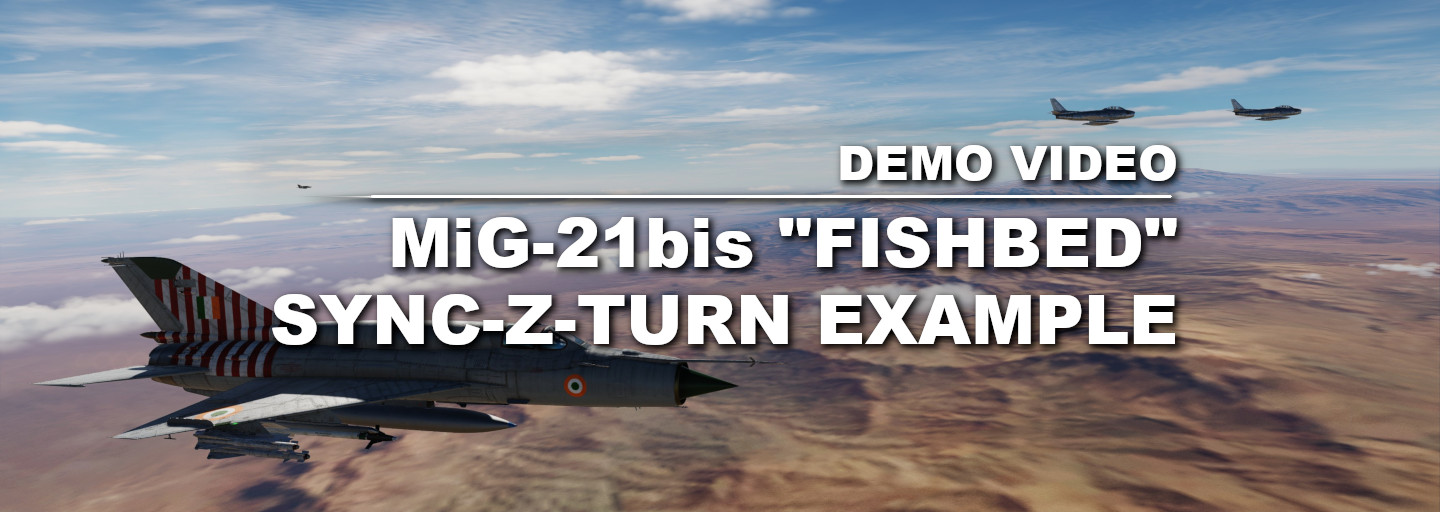

Unplanned initially, I later expanded the discussion about the Sync-Z-Turn to show how its fundament concepts can be applied (sometimes forcibly and with several adjustments) to other modules:
- Sync-Z-Turn: Explanation (F-4E)
- Mirage F1;
- F-14 Tomcat;
- F-5E-3 Tiger II;
- MiG-21bis;
- MiG-29 Fulcrum.
Video
At this point, not much is left from the flow of the Sync-Z-Turn discussed for the F-4E, but this is an example of how, playing a videogame, we can reinvent and reuse concepts to improve our experience and results.
The previous demo, featuring the F-5E, showed how weaker radar systems force the crew to react quickly. The performance of the RP-22 “Sapfir” used by the MiG-21bis is even worse. Ergo, the crew must act promptly and effectively. Needless to say, practice and experience play an important role in determining the outcome.
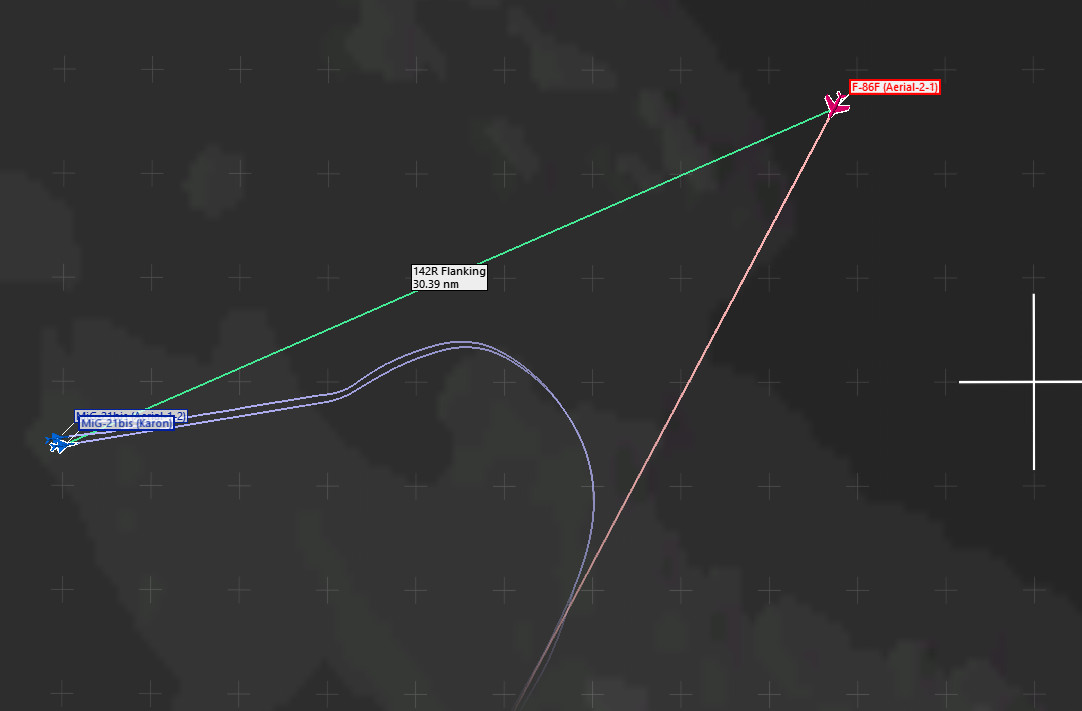
In this example, a section of Indian MiG-21s intercepts a group of bogeys. I obtained radar contact at circa 15 nm. The bogeys were close to the nose when they appeared on the scope, making the drift assessment much quicker, which benefitted the manoeuvre. The next steps follow the usual script: synch the target at a defined ATA, maintain the angles, and monitor the AoB. When appropriate, turn to pure and complete the conversion on the targets’ rear quarter.
All things considered, the turn resulted in a pretty satisfying conversion behind a pair of Pakistani F-86F. Now, all we need is a good overhaul of the wingman’s AI so it can properly position itself as a shooter or element performing the VID.
With this article & video, we conclude this impromptu mini-series. The original plan was to showcase only the F-4E Phantom II. It has been an interesting series. Through the eyes and sensors of different fighters and crews, we have seen how concepts and manoeuvres can be applied, with some adjustments in some cases, to other platforms. Each fighter had its own set of system deficiencies and features but, ultimately, all the five aeroplanes shown proved to be platforms that can take advantage of the fundamental concepts driving the Sync-Z-Turn.
 FlyAndWire