


The following article scratches the surface of a very complex topic: air-to-air operations and planning of a four-ship. Despite the high-level nature of this discussion, it offers several ideas easily re-applicable to most DCS gaming sessions.
Video
Author: Major Don Ross; Maxwell AFB
“While F-15 four-ship employment is becoming more prevalent throughout the Tactical Air Force (TAF), there are many options available to operate as an integral formation. Fighter Weapons School (FWS) instructor visits to units in the Tactical Air Command (TAC) and overseas bases continually highlight four-ship employment as an area needing emphasis. In spite of the additional complexities of using a four-ship over a two-ship, there are many ways to successfully employ a four-ship package in a variety of roles. This article will address some planning considerations and options available for the four-ship. Although the article specifically relates to the F-15, many concepts discussed will apply to other aircraft in the air-to-air (A/A) role.
Phisolophy
A four-ship flight is generally more effective if it is employed together as a visual formation and not as two elements. The concentration of firepower and availability of mutual support provides a greater guarantee of local numerical parity or superiority which is often more critical to mission success than are the overall arena numerical proportions. The other philosophy which will be emphsized throughout this article is the KISS principle. Execution is essential, but this can easily be degraded by complicated game plans.
Avionics
The avionics setup is vital to the effectiveness of four-ship planning. For F-15s, a common friendly squawk is a must. One of the modes (1 through 4) should be dedicated as a common friendly squawk. The others can be used to discretely identify aircraft, elements, etc. This common squawk gives F-15s an easy one-step method of distinguishing between friendlies and unknowns detected beyond visual range (BVR). The A/A Tactical Air Navigation (TACAN) can be set-up within elements or between elements. Because element mutual support is a higher priority as the intercept/engagement develops, using an A/A TACAN commonality within the element is a good starting point. When visual support is assured for each element, the option of A/A TACAN between element leads may temporarily be used to determine the position of the other element post-merge. One technique is to first establish A/A TACANS within the element (No. 1: 29X; No. 2: 92X; No. 3: 92Y; No 4: 29Y). Then, if the element leads desire information on their relative position, Number 1 or Number 3 can momentarily select the opposite band (X or Y). The radio call to make this change could be “Eagle, switch TACAN.” If there is doubt about which A/A TACAN setting is being used, then all flight members should go back to the original briefed setting.
Radio frequency utilization can significantly affect the tactical game plan. It is generally best to keep as many wingmen as possible on a common frequency. If needed, use discrete frequencies for intraflight communication. The philosophy should be: if it’s important enough to be said on the radio, it’s probably important enough for all the Blue Force to know. There are some intraflight radio calls that not everyone needs to hear; therefore, discrete frequencies should be used sparingly. If overused, aircrews may not hear what is being said on the common frequency and can lose sight of the Big Picture. Also, excessive use of discrete frequencies may cause pertinent information to not be transmitted to all concerned.
The Inertial Navigation System (INS) setup is another area in which the KISS principle is used. Keep INS points to a minimum. If Blue Force has a line-up card full of destinations and is using all of these, then there is too much heads-down time flying in a hostile environment.Ingress / Combat Air Patrol (CAP)
Another critical element of four-ship execution is communication. An effective communications plan assigns the priority and backup talkers. A good choice is to make element leads the priority communicators. Ground-controlled intercept (GCI) and wingmen talk by exception; however, when F-15s are heading away from the threat, GCI should have the radio priority because the original priority talkers aren’t seeing the threat picture. When the package is headed towards the threat, the F-15s are the priority talkers again. If GCI or wingmen can add pertinent data, then they must speak. If they agree with the picture, they remain silent. The less people are talking, the more they are listening, and the more situation awareness everyone has. How to speak is as important as when to talk. Although bearing, range, and altitude (BRA) seems self-explanatory, there are iterations. Bearing and range, then altitude and aspect angle is a good information format for a tactical situation. This is also a good format to use in reference to the aircraft or reference to a bullseye point. Increments of 10° are adequate for bearing. Although Military Radar Unit (MRU) equipment can read out units for bearing, this has little meaning in a tactical environment. There is one technique that drops bearing from a BRA call for the sake of brevity. Bearing is assumed to be within 30° of the nose unless it is called left or right for more than 30°. This is not descriptive enough when a 20º azimuth split at 25 nautical miles (NM) is 7.5 NM (these are essentially separate vectors). This also cuts MRU out of the picture when the sites are unsure of fighter heading. Overall, more is usually lost than gained by using this technique. Another area where the KISS principle applies is the four-ship premerge formation. Although there are many premerge options, first and foremost, the formation should be easy to fly. If a wingman loses visual or has to dedicate too much effort to maintaining a formation position, he is not contributing enough to the tactical effectiveness of the four-ship package. Whatever the formation, the tighter it is, the easier it is to fly. A tight formation offers other advantages, such as hiding numbers. Further, it yields meaningful BRA calls since bearing and range are essentially the same in relation to anyone in the formation. Tight means within 2 miles for each F-15.
Radar and visual search responsibilities in a four-ship flight should also be simple. The radar search should match the comm priorities. If element leads have the comm priority, then they should be searching the entire threat arena. Each element should also search independently. In the case where element leads are the priority talkers, a logical radar search plan would be:
- Eagle 1 Low
- Eagle 2 High
- Raven 1 High
- Raven 2 Low
An exception to this should be made if it is anticipated that the majority of threats will be found in one altitude band. For an expected low altitude threat, a logical search would be:
- Eagle 1 Low
- Eagle 2 Low
- Raven 1 Low
- Raven 2 High
Visual search responsibilities are simpler if they are done by element. This is the fundamental search pattern aircrews are used to and what will be used if the four-ship must be divided into two elements. Flying a formation position is the only visual support one element should owe to the other. If the four-ship is to execute a CAP scenario and stay in one geographic area, it will be easier if the force stays in a visual formation. Trying to orchestrate a four-ship commit from a racetrack CAP with elements split into hot and cold legs is extremely difficult and requires excessive comm plus visual and radar search. Also, if the four-ship does not get rejoined, the remainder of the intercept, sort, and merge may not go as briefed. Setting the CAP location back far enough is usually more effective. Surprises will probably be less likely and this helps keep the four-ship package together.
Intercept
The intercept profile needs to be coordinated and simple in order to arrive at the merge as a four-ship flight. Between the elements, power settings and/or airspeeds should be the same in order to preclude a late merge by the trailing element. Offset intercepts should consider all the players in a four-ship. Generally, the leader of an offset intercept should strive for a 20° to 30° maximum offset to keep from presenting gimbal problems to other members of the four-ship formation. Before deciding on a targeting plan, an overall targeting philosophy should be established. This would include scenario considerations such as the threat, rules of engagement (ROE), mission, and ordnance. A good general targeting philosophy is to target as many threat groups as possible with a priority that is established by their range and aspect. Another guideline is to strive not to fly past untargeted or unseen threats. Before assigning targeting responsibilities, the terms “threat” and “group” should be defined. A front aspect capable bogey is a threat if he’s on the scope, within 10 miles, and with a greater than 120° aspect angle. He’s also a threat in any aspect if he is within visual range of the formation. If he’s not front aspect capable, the aspect should be somewhat higher (greater than than 120°). The numbers above are only rules-of-thumb. If it is assumed that a bogey isn’t a threat and he ends up killing a member of the formation, a gross mistake has been made. A good definition of a group is a visual formation within 3 NM. That fits the targeting philosophy because an F-15 targeting one group has a good chance of picking up a tally on the entire formation. That F-15 pilot should be able to employ ordnance on more than one bandit or at least negate attacks from that formation. There are a number of ways to target. Two methods that are easy to understand and execute are targeting based on a range sort or an azimuth sort. Both should be intercept options, with the game plan determining the preferred targeting method. This ensures that the sort can be executed without comm if required. Range sorting lends itself to a box formation and to offset intercepts. Azimuth sorting best supports a wall formation and no offset intercepts. A good way to brief the targeting plan is to establish the targeting priorities. The priorities describe how to target one group, two groups, three groups, and four or more groups. With a targeting philosophy of prioritizing threats (if there are more than four groups), a four-ship package would target the four highest threats and then attempt to leapfrog through to the next series of threats. With less than four groups, a four-ship can target within groups. If a four-ship box formation has a priority range sort breakout, an example targeting plan is:
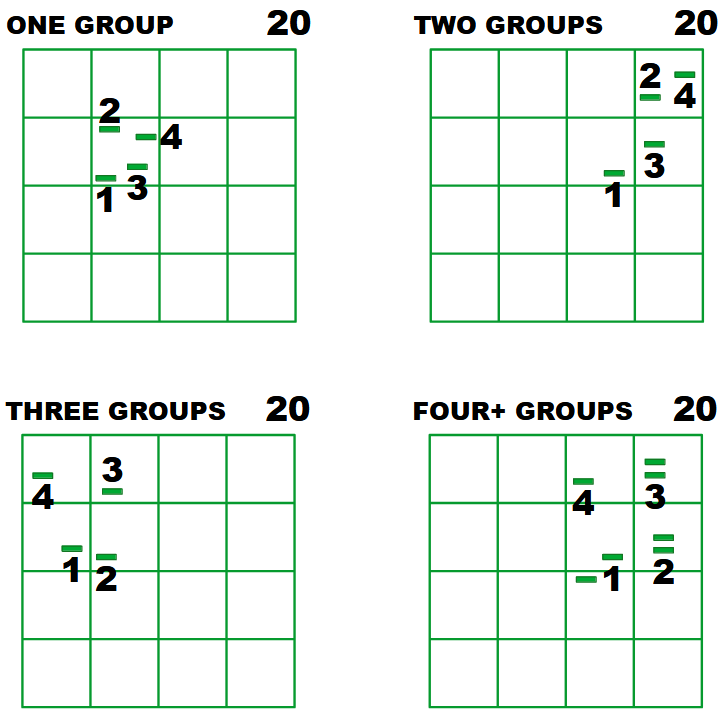
Another point to keep in mind when briefing a targeting plan is to keep this simple. You can’t cover all the contingencies, so don’t try. Just instil the targeting philosophy and priorities into the flight and let them apply this to the picture they see. Don’t make numerous “if/then” statements in a briefing; it makes the plan hard to understand and execute. A targeting plan can be executed only when everyone has the same vertical situation display (VSD). At a prebriefed sanitization range, everyone should attempt to overlap vertical coverage to look at the same picture unless the bogeys present an extreme vertical split. High/low targeting may be required for vertical splits.
Merge
A four-ship of Eagles entering a multibogey merge has the opportunity to achieve up to eight pre-merge kills. Their force multiplier is ordnance. Every member of a four-ship should strive to target one bandit with AIM-7s and another with AIM-9L/Ms. With that capability, they can change the force ratio from being outnumbered three-to-one to one of equal numbers. That is why a targeting philosophy of selecting as many threat groups as possible is desirable. In practicing post-merge four-ship employment, an offensive killer attitude will yield excellent results. If F-15s pass up premerge kill opportunities, their offensive status can quickly change to a defensive posture-especially when outnumbered. With an offensive targeting and killing philosophy in mind, a good prioritization of responsibilities for a four-ship is:
- Kill your assigned threat.
- Kill other threats.
- Help your wingman kill his threat.
- Exit and re-establish element mutual support if lost.
- Support the other element.
The best mutual support going into a multibogey merge is provided by reducing threat numbers pre-merge. If still outnumbered or not offensive at the merge, re-establish a mutual supportive formation and exit the area while taking shots that require minimum turning. At a multibogey merge, a four-ship formation normally will break down temporarily. Efforts to re-establish the four-ship formation can result in potential unobserved entries by bandits. Element integrity should be maintained first; then, a similar flow plan will facilitate inter-element support. If one element gets engaged, the other should help if required. Inter-element support requires communication if elements are not in visual contact. Each element should keep the other posted on status and position. Although the tendency is to lose track of the other element, a coordinated four-ship flight can still be conducted if properly planned.
A four-ship formation offers another post-merge support option. If there is a breakdown of mutual support, then a single fighter may have an opportunity to join with the other element or another single ship. These “wingmen of opportunity” should be used for visual mutual support until a rendezvous with the correct wingman can be accomplished. A comm plan should be established to efficiently determine who the players are and who will assume the lead/wingman responsibilities. The formation’s primary concern should be to withdraw to a rendezvous area so they can find their original wingmen.Overall Considerations
This article offers some considerations to be addresed in four-ship mission planning. It also gives some planning considerations which have proven successful. Although four-ship planning and execution involves more consideration than two-ship employment, it can yield an excellent fighting force if well done. A coordinated four-ship is usually much more effective than two elements tied by only time and geography. Critical elements in four-ship effectiveness are a simple plan which maximizes pre-merge kills, a good comm plan, and a sound post-merge mutual support contract which utilizes inter- and intra-element support. Although two-ship formations are the basic fighting unit, a well-employed four-ship of Eagles is an extremely effective offensive A/A threat that can deal with any current adversary force, even when outnumbered.
 FlyAndWire