


Update 21/09/2024
After making the video, I have received plenty of great comments from the community, which cleared some doubts especially about the first two points I raised. In particular I have pinned ledude114 comment:
Most modern aircraft still does the track processing in RWS, it just shows a more “raw” view.
The F-15E Suite 4 (which is early 2000s) should also show track information in RWS. The F/A-18C Lot 20 (mid 2000s) also does all the TWS processing in RWS, and even displays it under the LTWS (Latent-TWS) option.
Generally, the TWS mode in those aircraft is to ensure proper track quality for launches, which would not be available in RWS.
Considering the JF-17 is a very modern (although cheap) aircraft, it wouldn’t surprise me if the tracking is done at all time.
I still have questions about the design at this stage. For instance, since RWS seems to drive the track generation, leaving TWS unconstrained would allow the pilot to move from a wider to a more focused volume, thus having a sort of HDTWS. Still, these are questions probably only system desisgners and engineers can answer.
These are the issues, later explained in more detail:
- Instantaneous Track-While-Scan;
- Unrestricted Track-While-Scan?
- Zero-Doppler and contacts illumination;
- Lack of proper English manual.
Insta-TWIZ
When I test a new module, I open one of my ad hoc “looping“ missions and sit down and watch the radar scope. This is where I immediately noticed something funny: what you can see in the video linked above at 00:58 is Range-While-Search 1B 15°. Switching to Track-While-Scan something curious happens: the tracks are already there.
As we know, if you are not new to these shores, TWS is limited to certain combinations of bars and azimuth in order to illuminate contacts at a fixed interval. The avionics computes changes between each refresh and determines tracks and other information. Needless to say, this is a great radar mode for situational awareness, but in real life, it is pretty bad for engaging targets. In DCS, it is instead the rule.
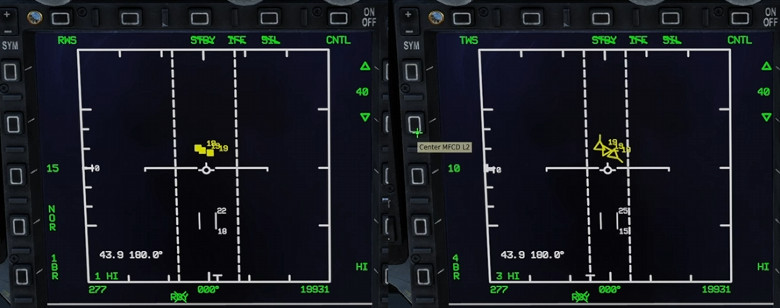
Back to the KJL-7, here is the question: if the avionics can compute tracks from RWS at such a low volume, why it is constrained when the selected mode is Track-while-scan? In other modules, switching from RWS to TWS takes a certain amount of time for tracks to be rebuilt.
Unconstrained TWS?
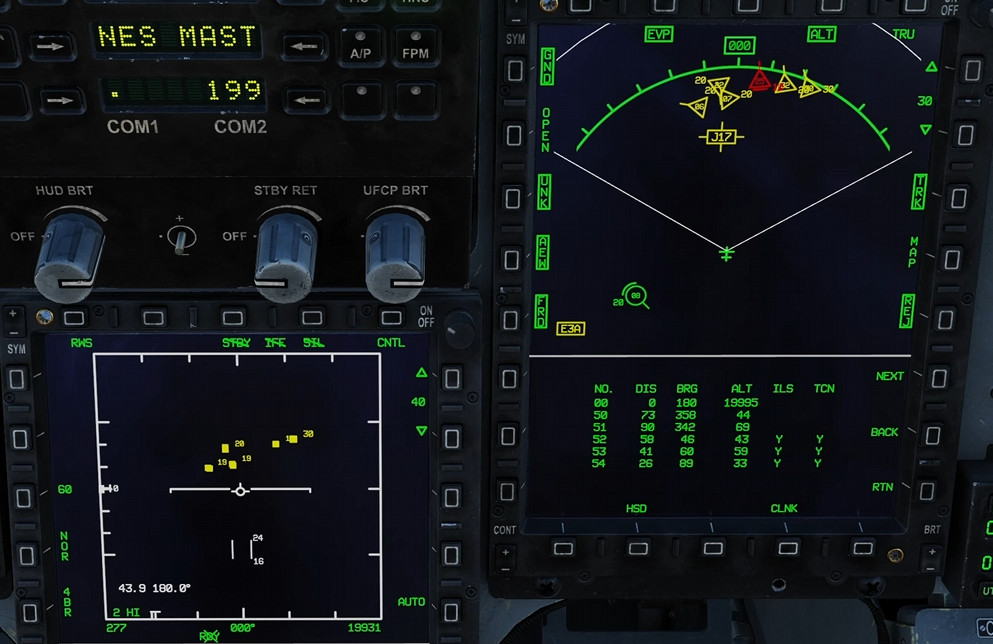
While checking the quick guide for the Datalink information, I noticed a couple of neat features and another curious fact. Once the dedicated display is set up, it shows contact tracks when the KJL-7 is in Track-While-Scan, plus additional information from other donors. But look what happens if I am the only JF-17 in the mission and I switch from TWS to Range-while-search. Similarly to the previous point I raised, RWS is capable of generating and updating tracks. This means I can now set my radar beyond the limitations of TWS, for instance, 60° 4 bars, and see the tracks anyway!
Zero-Doppler
The AWG-9 of the F-14 Tomcat has two major blind spots when operated in High Pulse Repetition Frequency, Pulse Doppler mode. One is the MLC Filter, or Mainlobe Clutter Filter, which prevents ground returns from being displayed. Simply put, this is what causes notching targets to disappear. The second is the ZDF, or Zero-Doppler Filter, representing the case where the Doppler effect is absent or minimal. For instance, when the fighter and bandit travel in the same direction at the same speed. The AWG-9 has a ±100 kts bracket where contacts vanish.
Other modules represent zero-Doppler, but here I noticed something curious. Namely, contacts are not always dropped. I have not discovered a pattern yet, but I wonder if S/N simulation, assuming it is implemented, may cause such behaviour.
No English Manual
Some of the simple questions I raised in this video may find an answer in the manual. But there is no manual. Only a quick guide has been translated into English, as the more comprehensive document is still in Chinese. Although Google Translate exists, this makes the learning process much slower. Personally, I am not really happy about this situation, and I would like to see the complete manual properly translated into English.
Conclusions
Of course, ten minutes is nowhere near enough time to judge a module, and that is not the point of the video either. The points I raised are not a critique at all (besides the last one) but rather sheer curiosity about this aeroplane.
The KJL-7, in particular, is worth a deeper look. I noticed a couple of nice touches, which I will cover in a later video if you want to see more about the JF-17.
 FlyAndWire