


Results & Charts
The complete set of results, tables and charts, is available here.
Tests & Scenarios
The closure and altitude scenarios used in Part I are reapplied here, but at a fixed distance, selected by considering the shortest FLO. Such evaluation excludes the R-77. This Russian missile does not loft, and its maximum range is, therefore, quite limited. I have also augmented the results of Test II and Test III by running them again and manually lofting the missiles.
Recap
Scenario II: “Cranking”, 0 TA, 0 ATA. Post-launch, 60° crank.
| Test | Altitude | VFGT | VTGT | SEP | SEPR77 |
| Test I | 10,000 | M.9 | M.8 | 14 nm | 11 nm |
| Test II | 25,000 | M1 | M.8 | 23 nm | 19 nm |
| Test III | 35,000 | M1.2 | M.9 | 30 nm | 26 nm |
Results: 35k
Let’s start by looking high up to the 35,000 ft scenario. The employment range is 30 nm.
There is not really much to say about the dead-ahead case, no missile had any issue hitting their target, with the mentioned exception of the R-77, which the AI does not employ farther than circa 26 nm. The SD-10 proves itself to be better under most metrics: it arrives faster, flies faster on average and therefore arrives earlier.
The crank scenario shows one of the advantages of the AIM-54 Phoenix: cruising at high altitudes, even for a brief period, allows the missile to manage its energy better, resulting in greater impact speed. The R-77 lacks this particular feature and runs out of energy.
I have decided to run each missile manually, adding some loft. It is worth noting that the shown values are not the most efficient combinations, so there is room for the try-harder ( :p ) among you to squeeze a bit more juice.
The percentages represent the difference between default and manual loft even better. The 54s gain less, given their already arcuated trajectory. Everyone else wins a free two-figures impact speed. Not bad.
Results: 25k
At mid-to-high altitudes, the different characteristics of the atmosphere do have an impact on missiles. At these altitudes and speeds, the AIM-54 still retains good characteristics, but we are close to the range at which its behaviour suddenly changes. This is probably the symptom of its ability to reach very high altitudes, twice or thrice as other missiles, thus retaining more energy.
In this scenario and the previous, the SD-10 appeared to be the best-performing. The AIM-120C-5 is close but always slightly worse. I suppose a more modern 120C-dash-7, featuring improved guidance and range, fielded in 2008, would turn the advantage again towards the US and NATO sides.
The crank scenario shows the slight advantage of the Phoenix vanishing due to its size, weight and drag. The SD-10 and the AIM-120C-5 are also affected, losing circa 15% of their impact speed, whereas the AIM-54 loses over 20%. Surprisingly, the AIM-120B is the best performer, losing only circa 13% speed at impact.
Things suddenly change when the manual loft is introduced. This manoeuvre allows missiles to reach that thin air they all love, and the results are impressive. The SD-10, for example, gains between 25% and 30% greater impact speed, with the average speed increased by circa 10%.
Overall, we can see how manual loft drastically helps when the target manoeuvres.
Results: 10k
If the results of 25,000 and 35,000 ft are somewhat comparable, at 10,000 ft, everything changes. Fighters struggle more to reach supersonic speed, and the missiles will not reach the same high altitude, drastically impacting their maximum range and ability to retain speed.
In this scenario, we are very close to crossing from Beyond to Within Visual Range.
Even in the “dead-ahead” series, missiles arrive with low energy with an equally low average speed, and the effects are exacerbated in the “cranking” scenario.
It is worth noting that the AIM-54 Phoenix does not loft within circa 21 nm. Therefore, the longer it flies after the rocket motor is exhausted, the less energy it will have.
Nevertheless, both rocket motors burn for an eternity, compared to other missiles, and this characteristic allows them to endure for the first 27-30 seconds. The Mk-47 has a slight edge due to being the one that burns longer.
The AIM-120C-5 performs as expected, arriving second under most metrics, fairly close to the SD-10. The dual-thrust motor of the Sino-Pakistani missile gives it an advantage at lower altitudes, an effect somewhat comparable to the AIM-54 Mk47. In fact, I am surprised by the ability of the SD-10 to maintain both a high average speed and the best impact speed of the study. Although the impact speed, per sé, is not such a fundamental parameter, the more energy a missile has, the better it can respond to sudden geometry changes as the target defends.
The crank scenario at this range and altitude further highlights the struggle, with three out of six missiles failing to connect.
The characteristics of the SD-10 make it a reliable missile even against a cranking target. In fact, it performed uncomfortably close, and in some cases better, than how the AMRAAM-C did at 25,000ft.
Although the AIM-54C Mk60 and the AIM-120B did not connect, they arrived very close to the target, within circa 0.05 nm, basically 100 meters, from the target. A little difference in the firing parameters, and they would have been capable of hitting their designated target.
10,000ft Manual loft: New Scenarios
I decided to do something different for the manual loft scenario at 10,000ft.
Pitching up while employing allows missiles to briefly dip into the higher, thinner air, allowing them to cruise faster and invest more energy in the terminal phase.
However, I am not entirely sure how feasible pitching up 30° at 14 nm with VC close to Mach 2.0 is. The manoeuvre leaves the fighter exposed: slower, in an awkward position where it is hard to defend. So, I decided to spice things up and check how well missiles deal on their own. The dynamic of the test is simple: pitch up, employ, and after separation, hard roll 180° and pull. De facto a launch followed by a split-s. The complete results are linked at the beginning of the article.
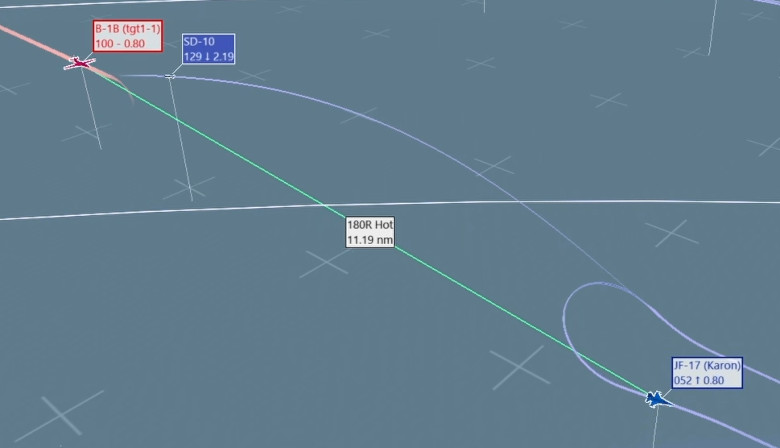
The AIM-54 gains massively by manual loft at these ranges: the rocket motors burn for ages, and the additional pitch allows them to somewhat mimic their longer-range envelope. Moreover, when launched in Pulse mode, the Phoenix is active off the rail, and no additional support is required. SD-10 and the AIM-120s gain around 15% greater impact speed. The only outliner is the R-77: the performance of the missiles with the parameters of this test is not enough to make this missile a threat at 14 nm.
Lastly, rather than testing the “cranking scenario”, I wanted to see what happens when a more lively target is engaged. I used a veteran AI as a target and followed the same modus operandi just described.
Once again, only three out of six missiles found their target. The three defeated missiles were all notched and did not attempt to reacquire the target.
Besides the old doubts about notching in DCS, it is remarkable how manual lofting allows every missile to potentially have enough energy to connect to a manoeuvring target, except for the R-77, which struggles at these ranges.
Conclusions
The second part of the Active Radar Homing missiles study highlighted how the SD-10, generally considered in real life somewhat between the AIM-120B and the C-5, performs slightly better overall than the latter. The difference is not that much, to the extent that, as shown in Part I, the performance of the launching platform can have a much greater effect on the outcome of a fight.
When older missiles are discussed, such as the Phoenix or the R-77, it is abundantly clear how technology and geopolitics have left a mark, so chucking them all together in the same arena with missiles 30 years more modern really makes little sense.
I would like to stress how, no matter the numbers, it is the pilots’ and crews’ ability to generate Situational Awareness and manage it along their aeroplane that, the vast majority of the time, will crown the winner. More advanced avionics, missiles, bugs and exploits definitely help to gain an edge, but only when the crews are equally capable.
I hope this study has helped you better understand the discussed missiles’ peculiarities and performance characteristics.
 FlyAndWire