
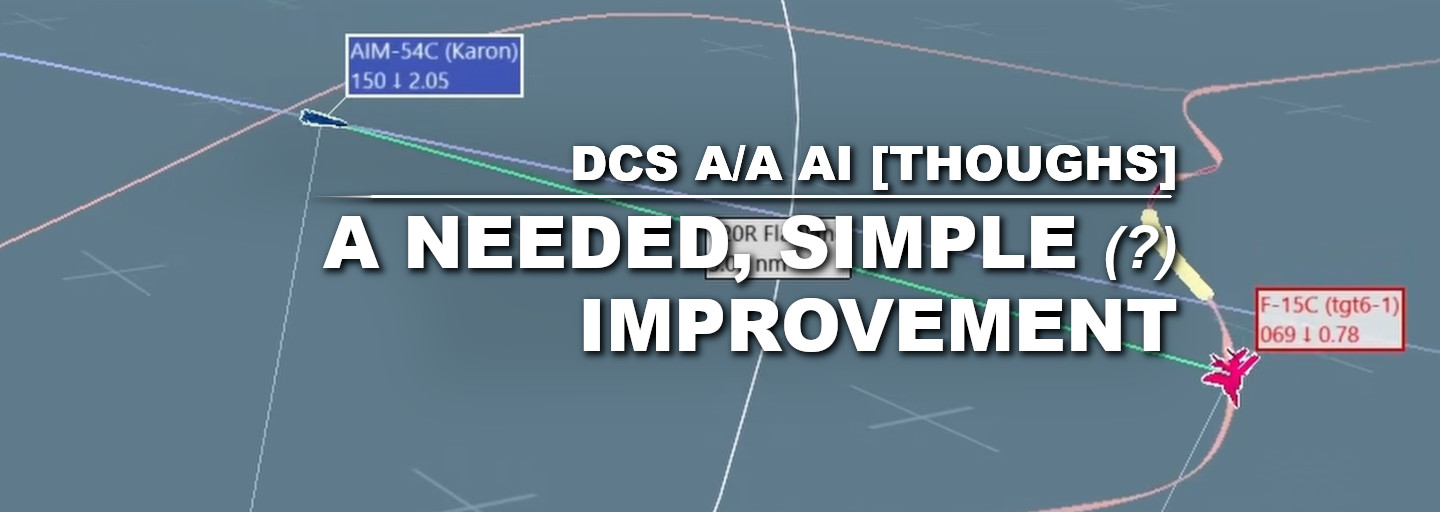

In my recent study about Active Radar Homing missiles in DCS, I included a brief extract from an AIM-54 Phoenix’s perspective, closing in on a veteran AI who chaffed, notched, and defeated the missile. However, what happened in the following couple of seconds is what I despise the most about DCS’ AI, and it is somewhat similar to what they improved fairly recently, but in a different context.
Let’s start by watching the video titled “Active Radar Homing Missiles II: Performance Comparison”. Timestamp is 8m33s:
Have you seen that? No, I don’t mean the notching, we all know the AI is way too good at that. I meant how the F-15 turned hot again the nanosecond the missile went dumb. Let’s watch the action again. This is the moment the missile is thrashed. The AI has stopped chaffing and it started the turn. How is this possible? The AIM-54’s seeker is still active. From the F-15’s perspective, there is no way to know with such precision that the missile is now dumb.
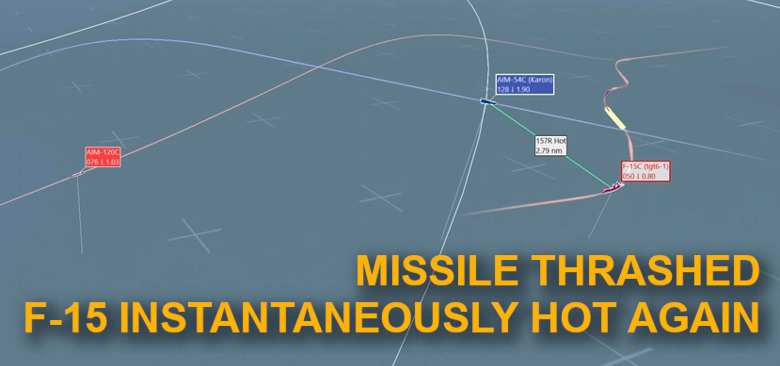
So, would a simple solution be, at least on paper? Simply put, apply the recent changes to SAM to air-to-air missiles. The current implementation, in fact, seems to rely on a simple flag: is the target locked? If yes, then the aircraft should defend. If not, the aircraft can resume. This is hardly news; we have seen this behaviour time and time again in the tests I published here. The most visible was the PSTT Phoenix employment.
So, how would this improve the experience? In simple terms, the F-15 would continue to chaff and defend for a few more seconds. As the Eagle escapes the seeker’s cone, its RWR is “naked”, and the AI turns into our fighter again, precisely as most humans would do. Yes, there are other things experienced humans may do, some legit tactics, and others exploits, but this would be a neat improvement.
A Different Approach
As a possible simple advancement to the AI dynamics, again at least on paper, I would add randomised delays to the AI’s actions queue.
In this case, the AI’s lightning-fast reaction time was both unrealistic and gave away the opponent’s nature. What would a human do instead? In primis, as the RWR goes off, the pilot looks at it, and identifies the type of threat and the direction. Then immediately turns into the beam. How long does this process take? Well, it depends. An experienced pilot surely expects danger from that bearing, so let’s say a second or two. An ab initio player may be startled by the RWR, and the operation may require 3 to 5 seconds, for example. Each randomised value would be then adjusted coherently with the skill level. For instance:
- A Rookie AI would require between 2 to 5 seconds to react, with an average reaction time of 3.5s. Each of us DCS players knows the feeling of being overwhelmed and lost and the struggle to build Situational Awareness of our very first hours in the cockpit. However, each of us has different qualities, and some, albeit inexperienced, are more reactive than others.
- The Trained AI would have the same interval reduced by 30%. Therefore, between 1.4 and 3.5 seconds. The average would be circa 2.5 seconds. Just the time to look at the RWR, register the direction of the threat and initiate the turn. This AI would represent someone who has completed basic training, has good understanding of their aircraft, but has no combat experience. Unexpected events such as the RWR going off, may still require a second to regain composure before registering and reacting.
- Veterans can predict how most situations evolve and have good Situational Awareness. The interval would then decrease by 60%, ergo, between 0.8s and 2s. The average is less than 1.5s. This is a real veteran pilot. Someone who has extremely good Situational Awareness and expects the threat. For instance, a pilot is cranking with a hostile 30R and expects an incoming missile. Given the crank and the lead of the missile, he expects something between 10R and 20R. As the RWR goes off, a glance at the instrument, and he just has to tighten the left turn.
- Ace AI is UFO-piloted. The values would be decreased by 90% or just set to zero. At the moment, Ace AI has no place in DCS, in my opinion.
This randomisation should not apply to every action, but only to reactions to unexpected situations, such as being engaged by missiles or jumped on and gunned. Yes, guns. If you look at the Second World War, Korea, Vietnam, and other footage of gun kills, many times, the target did not react, not even after the first couple of bursts.
I do not know if these suggestions can be useful, as I don’t know if the AI is event-driven or polling-based on a bunch of variables. Still, I would love to see these simple improvements, which, on paper, are not too invasive to apply and, one day, a complete overhaul of the air-to-air AI.
 FlyAndWire