

Ground + Reheat
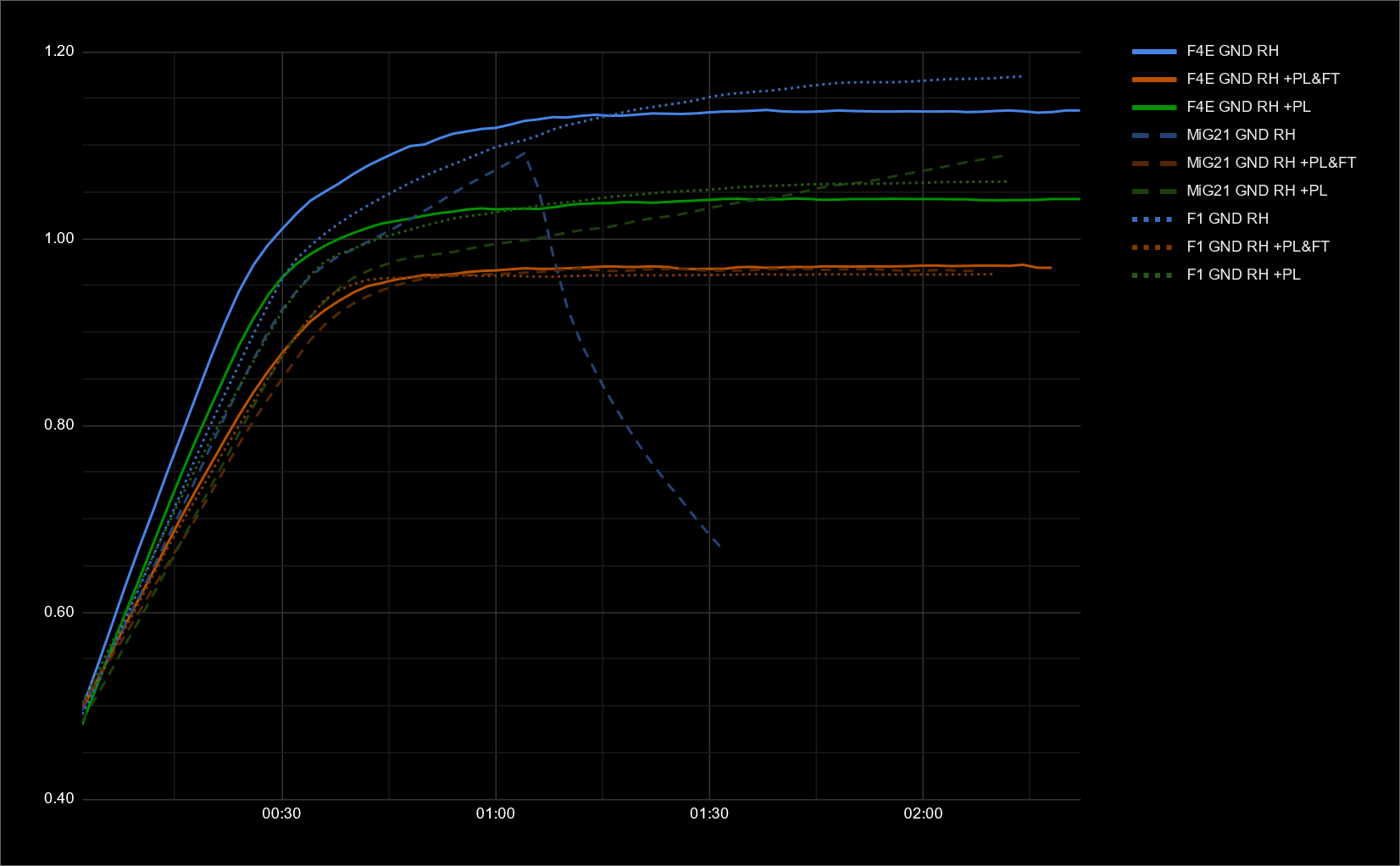
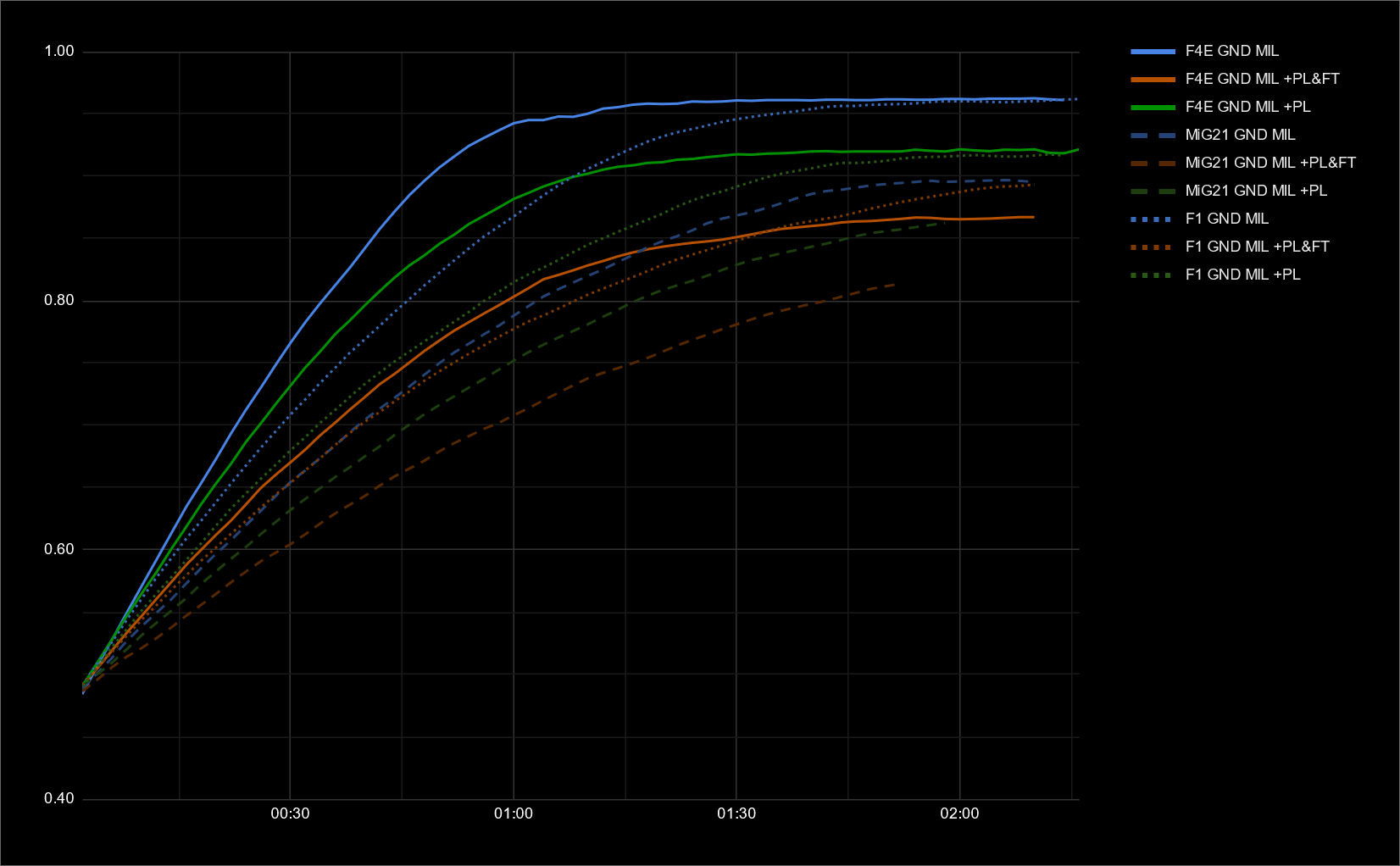
The complete data set chart shows the F-4E as a solid line, the MiG-21 as a dashes, and the Mirage F1 as a dotted line. This arrangement is maintained throughout the study.
Clean aircraft
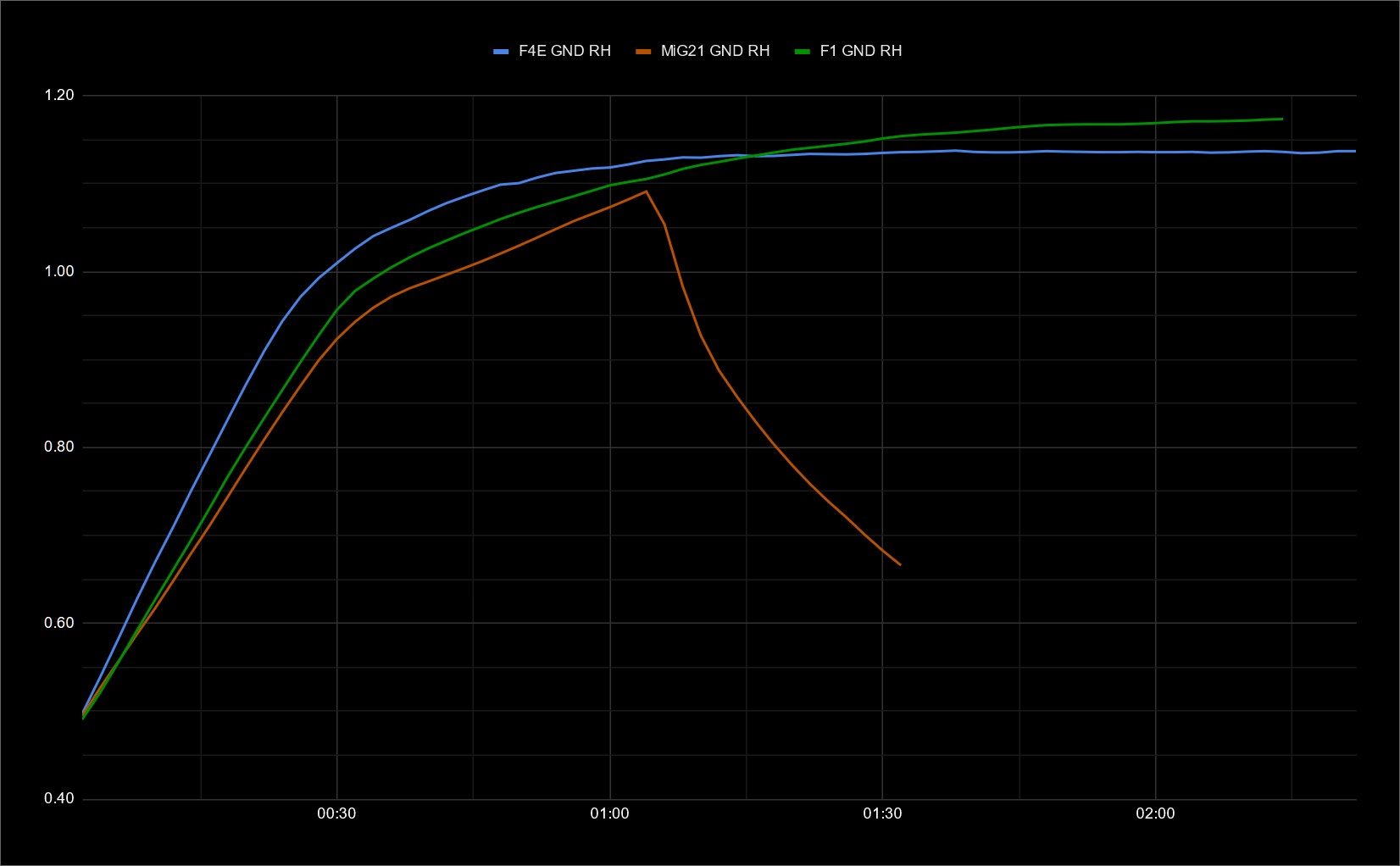
Isolating the clean configurations shows how the F-4E has slightly better acceleration until the second part of the transonic region. At a speed of circa M1.10, the Tumansky turbojet powering the MiG-21bis gives up, and almost at the same time, the Mirage F1 surpasses the Phantom in terms of peak speed. The French aircraft continues its acceleration, whereas the pair of General Electric J79 settles the Phantom at circa M1.15.
Payload & Fuel Tanks
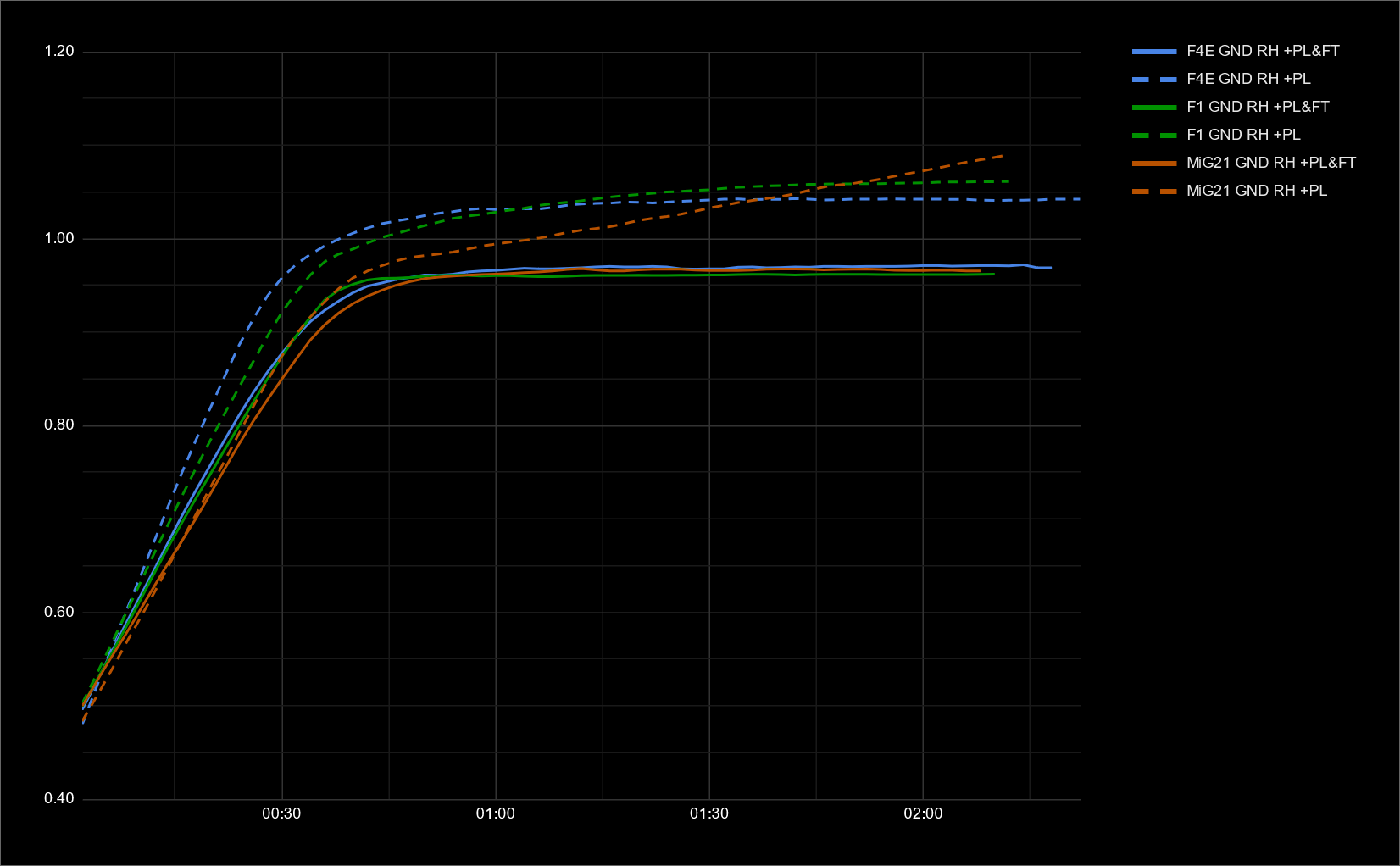
The next chart is much more interesting since clean aircraft are rarely a thing in DCS. It is immediately observable how the three aeroplanes “beach” themselves between M.9 and M1. There is fundamentally no difference between them, and any is within the margin of error for this empirical study when non-fly-by-wire aircraft are considered.
The air-to-air configurations without fuel tanks are more applicable to a DCS scenario. Let’s imagine the pilots have jettisoned their fuel tanks as they commit and rushed towards their targets. In this scenario, the Phantom II outguns the competition, carrying eight missiles against the six and four of MiG-21 and Mirage F1. Nevertheless, the J79s show their muscles and the American fighter shows a slight advantage acceleration-wise. The difference between the F-4 and the F1 is minimal; both settle at similar speeds. Curiously, the MiG-21 is the slowest until circa M1.05. Moreover, the trend is distinctly more aggressive. Once again, the pilot must be very careful and manage their speed, or they risk overspeeding the engine even with an external payload.
Ground + Military Thrust
The next series of charts compares ground-level and military thrust performance.
Clean aircraft
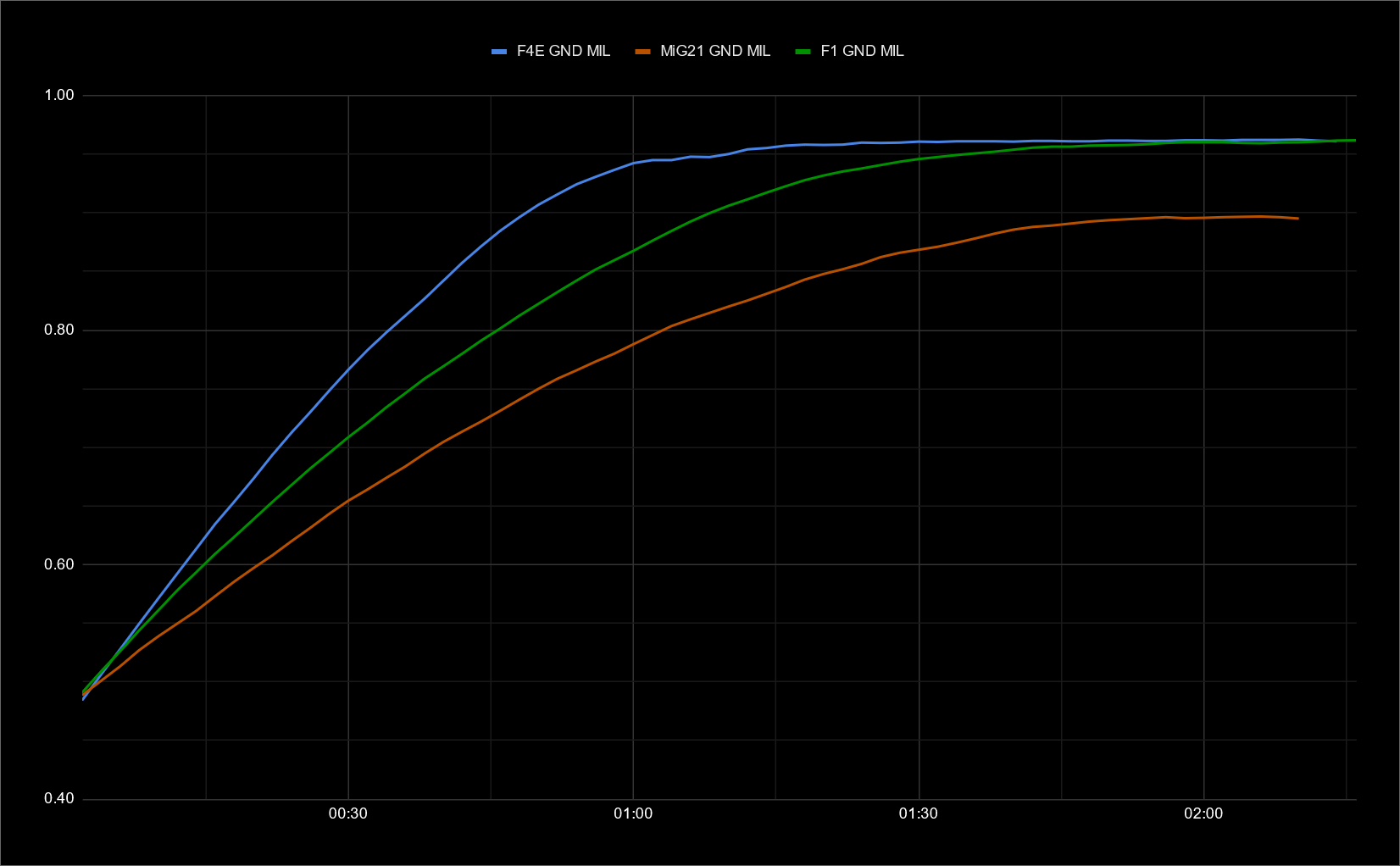
The clean configuration results show a trend similar to the ground plus reheat scenario. The F-4E delivers better acceleration again, but the Mirage F1 follows closely behind. Both settle at a speed of circa M.95. The MiG-21, instead, is the slowest of the three, settling at M.9 and requiring a much more extended period to get there.
Payload & Fuel Tanks
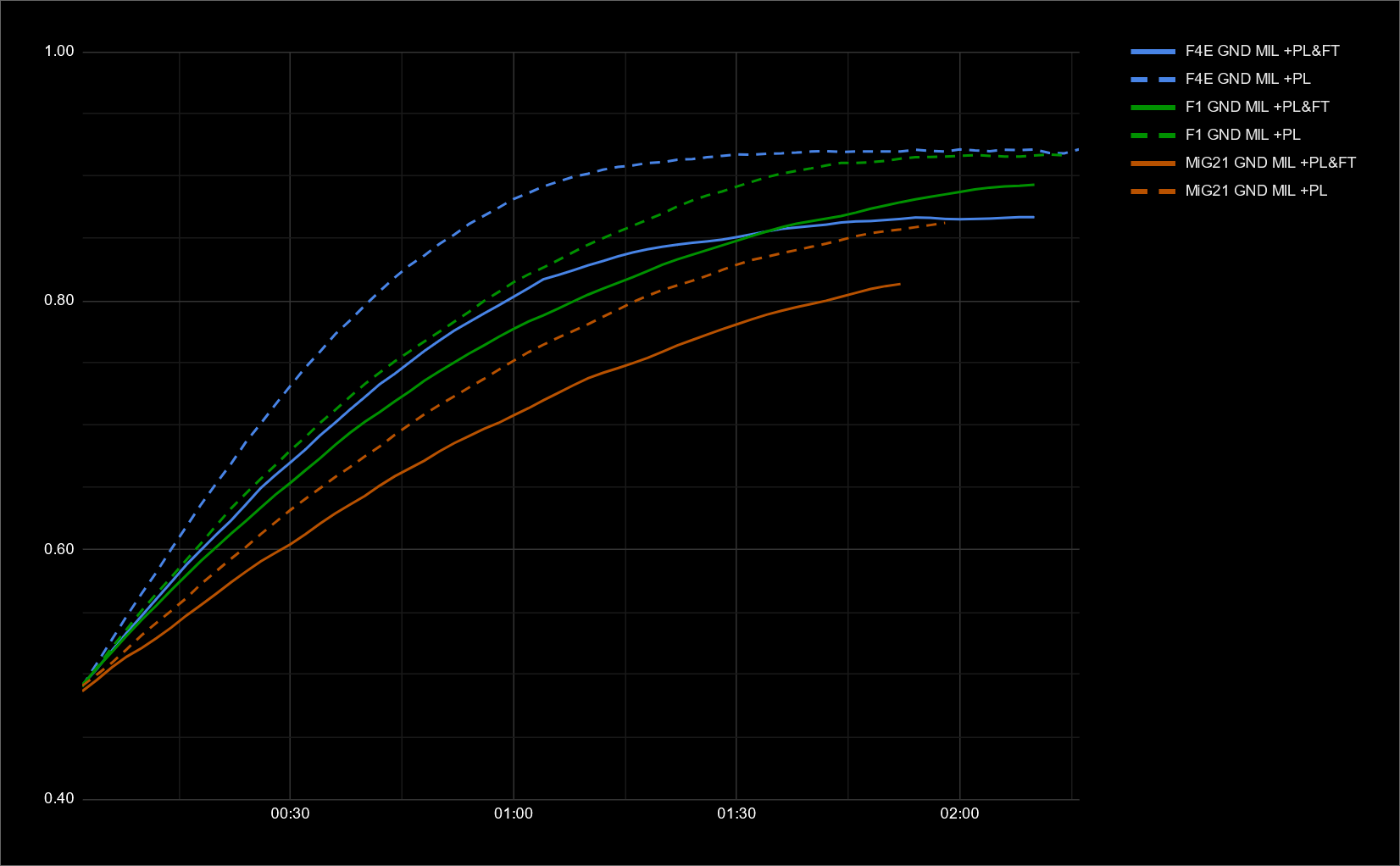
Once again, the comparison with an air-to-air payload and fuel tanks is particularly interesting. The Phantom has good acceleration, but after circa M.85, the Mirage F1 retakes the lead. More importantly, the acceleration of the French aircraft past this point continues. The MiG-21bis lags behind. Its trend is not dissimilar from the F1’s, but it is about half a Mach slower.
It is worth remembering that the Phantom’s configuration features three fuel tanks, compared to the single tanks of the MiG-21 and the F1. If the F-4E’s crew were to ditch their bags, they would find themselves in a whole better aircraft. As the dashed lines show, the 4-by-4 Phantom takes the lead by brute force, showing greater acceleration and settling along the slightly slower Mirage F1 at M.9. The Soviet MiG-21’s curve appears again to mimic the F1, but with a negative offset. Looking at the aircraft reference table attached to the previous part, we can probably explain how the much heavier Phantom performs so well. Its pair of J79 turbojet, in fact, produce more than twice the amount of thrust than the Atar 9K-50 and the Tumansky R25-300. Although not particularly powerful by modern standards, the J79 is a solid engine compared to its peers.
30,000ft + Reheat
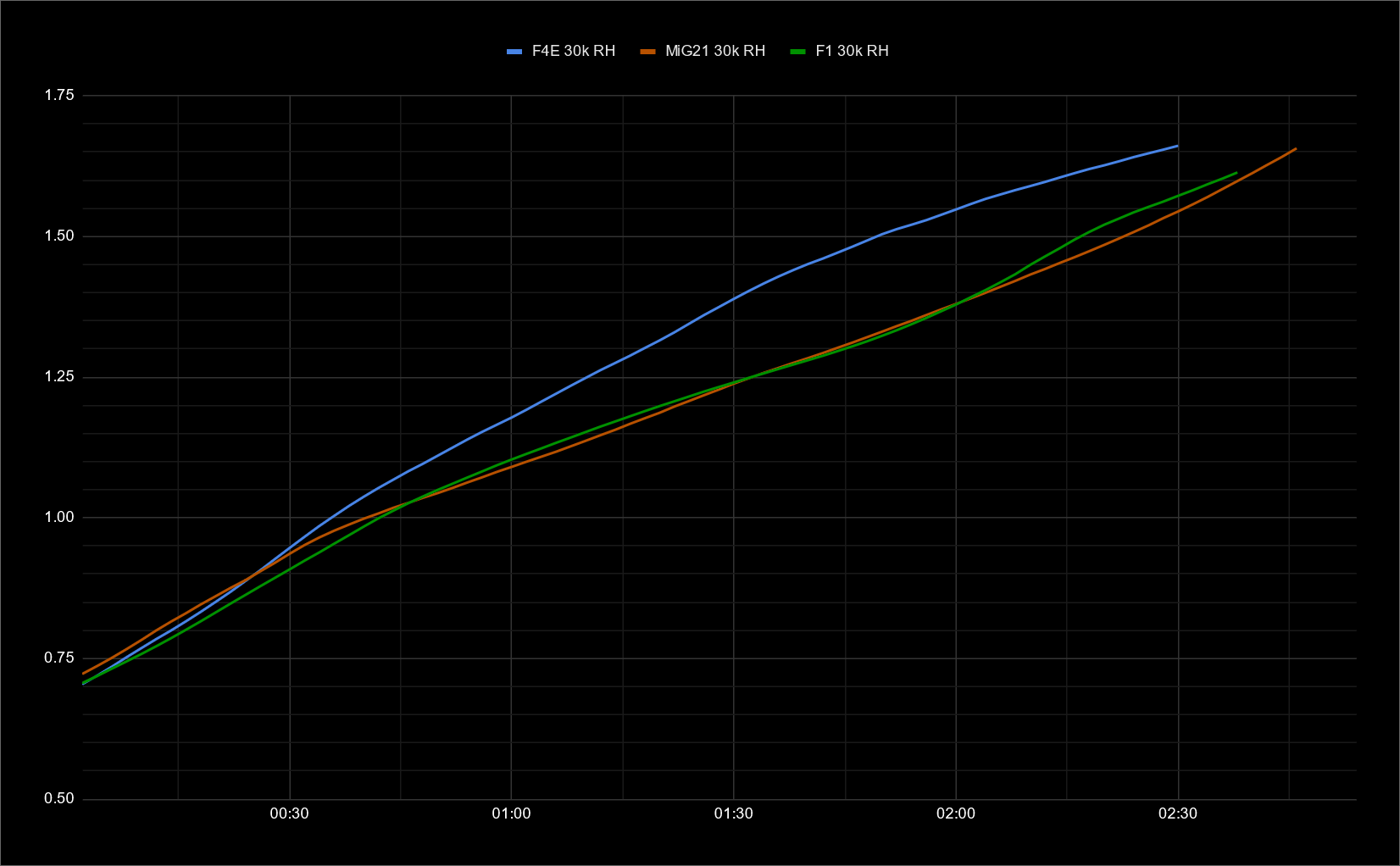
At 30,000ft, in the cold, thinner air, the reduced drag benefits the aircraft’s performance. Starting from the reheat set of data, we see only one series struggling to break through the transonic region.
Clean aircraft
Let’s follow the usual order. The Clean configuration shows the three fighters flying like rockets, following similar trends. The Phantom shows better acceleration after the transonic speeds, but all reach a speed close to Mach 1.6 at the end of the test. Besides that, there is not a lot to say in this scenario, so let’s move forward to the air-to-air and bags set of tests.
Payload & Fuel Tanks
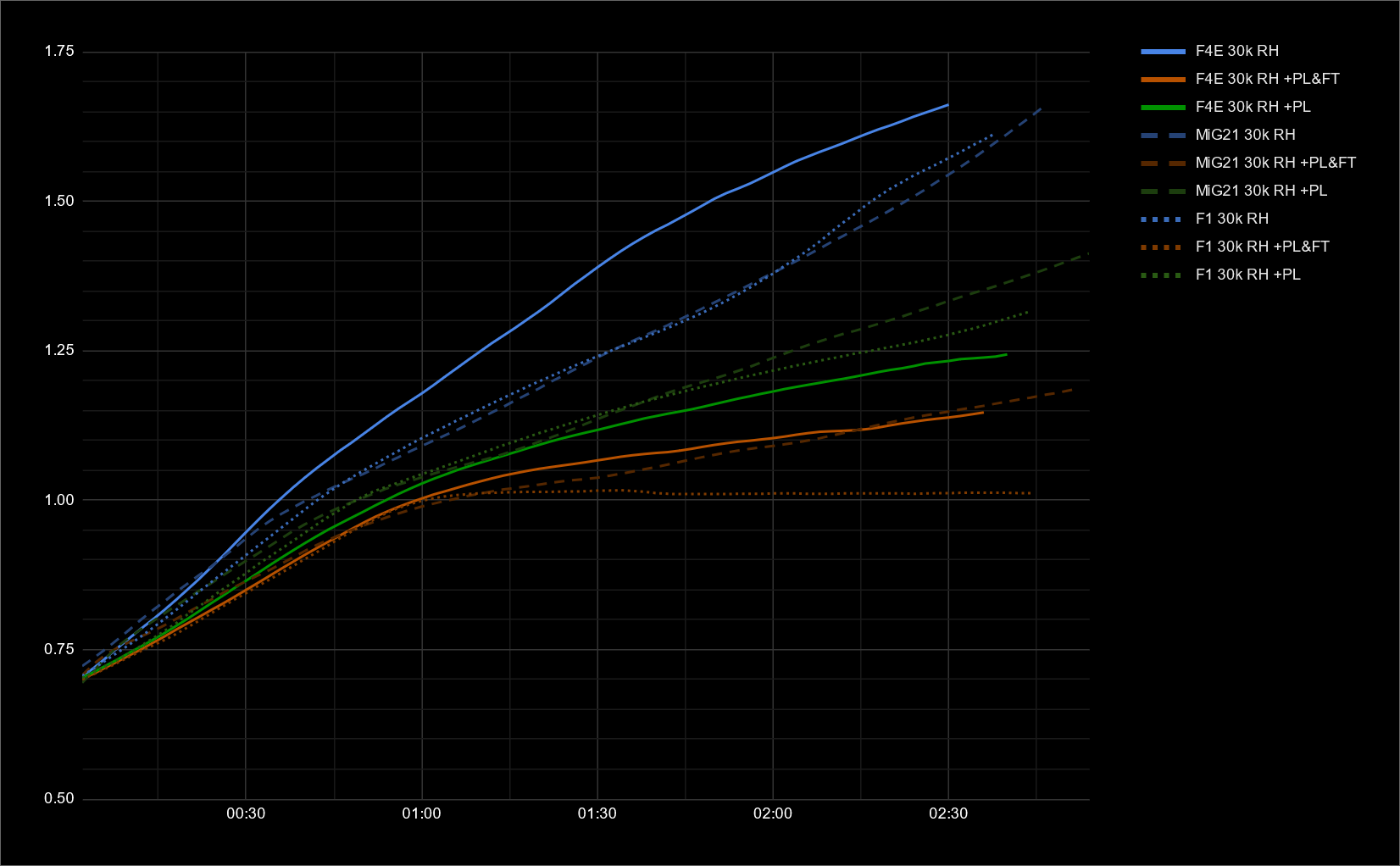
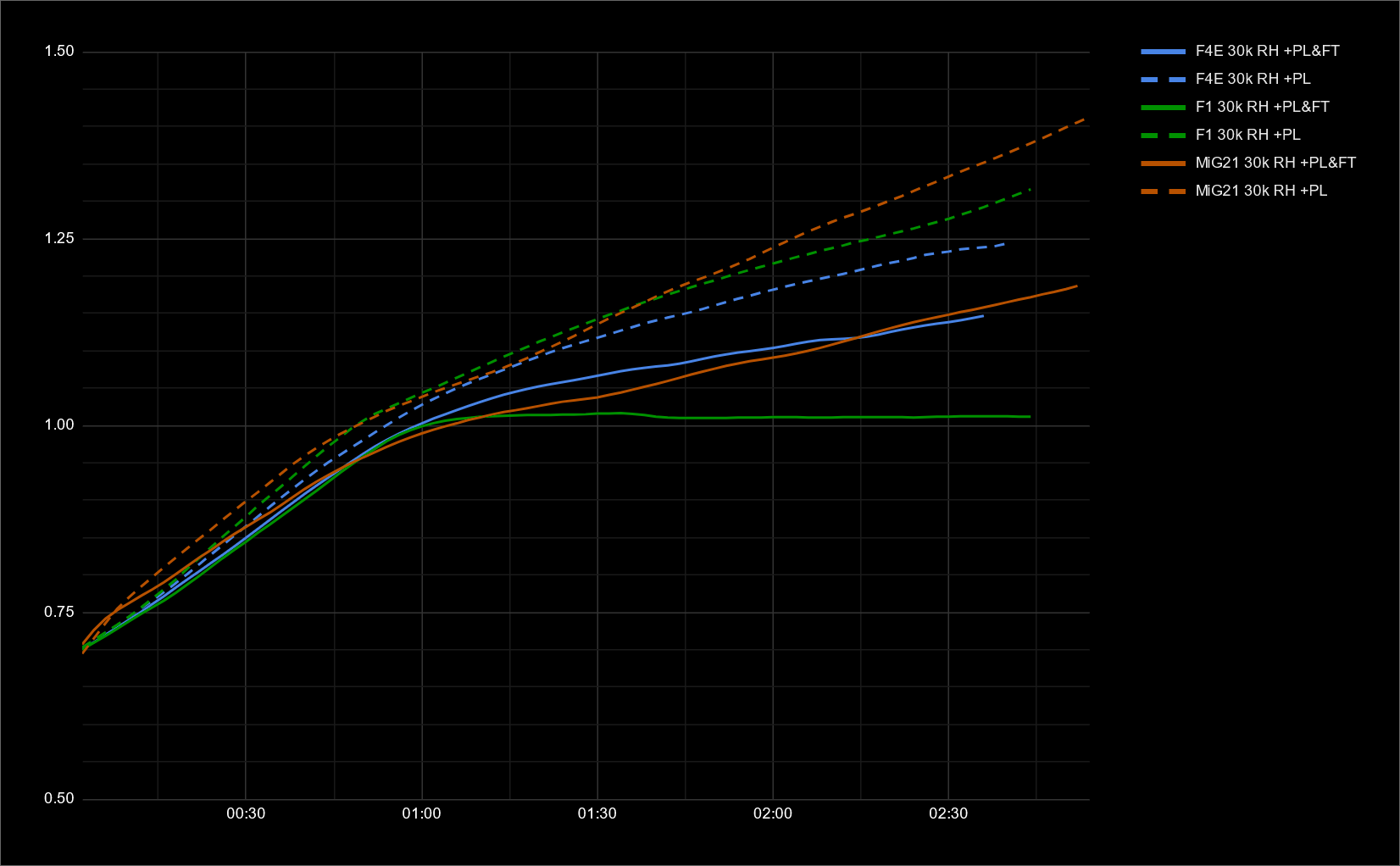
Here, something *inconceivable* happens: the Phantom is not the fastest anymore! Joke asides and conscious of the loadout differences, we now finally see the MiG-21 bolting forward in the configuration without a fuel tank. Curiously, this happens only past the transonic region, and before circa M1.15 – M1.2, the three fighter jets score similar results.
I look forward to testing the “hard wing” F-4, which should be extremely fast in this region of the envelope.
Adding fuel tanks to the aeroplanes drags them down considerably. Still, both the Phantom II and the MiG-21 manage to accelerate through the transonic region, with the F-4 apparently having ever so slightly better acceleration until the Soviet aircraft takes over in the final stretch of the test. The Mirage F1, surprisingly, gets stuck at the high-drag barrier constituted by M1. This is possibly another case solvable by a slight unload to enter supersonic speed, after which the F1 should continue its acceleration. In order to maintain the integrity of the study, however, I avoided such a manoeuvre.
30,000ft + Military Thrust
And here we are, to the final set of charts: 30,000ft without reheat. Nah, I’m joking. There is still the fuel consumption to discuss after this section!
Clean aircraft
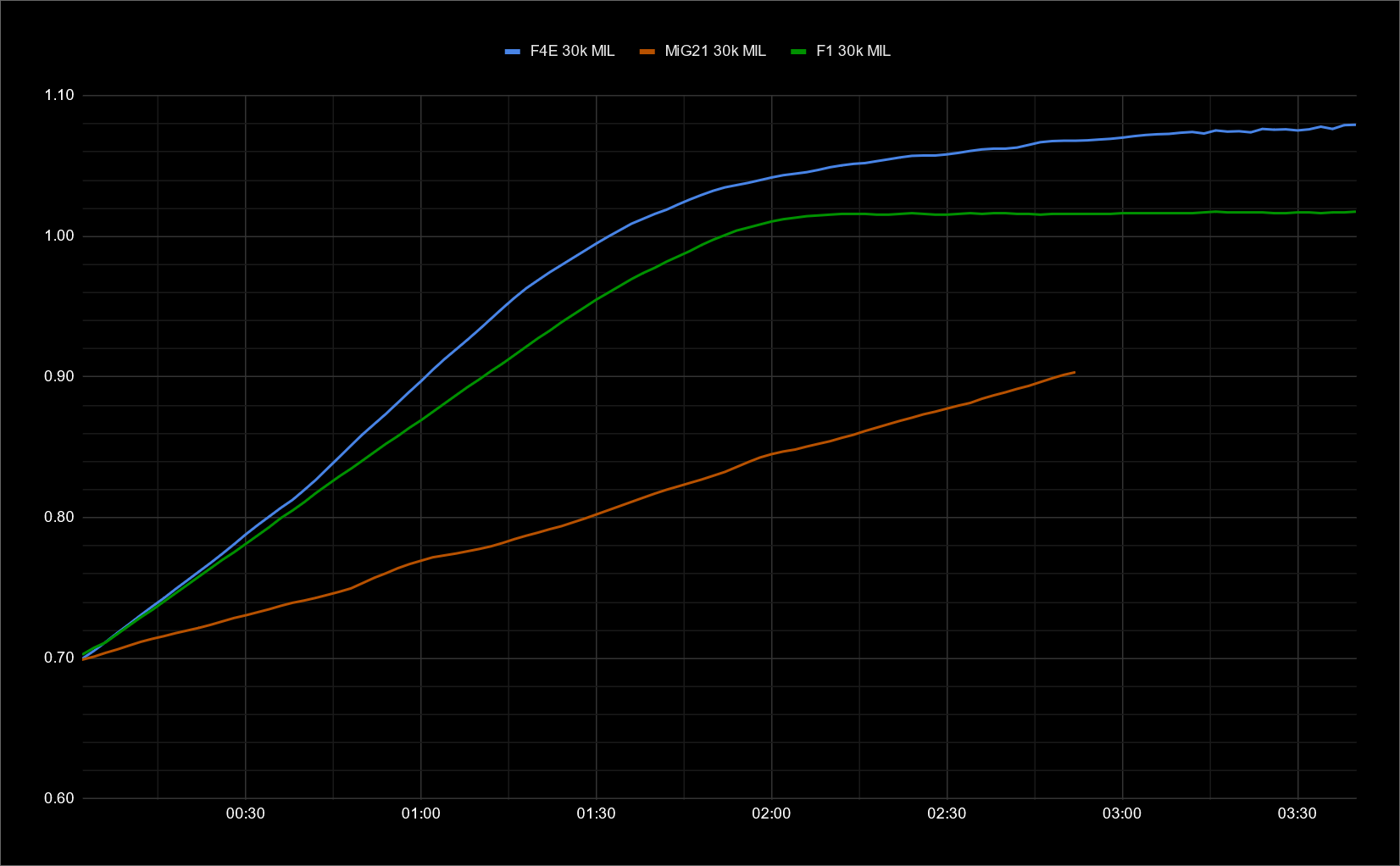
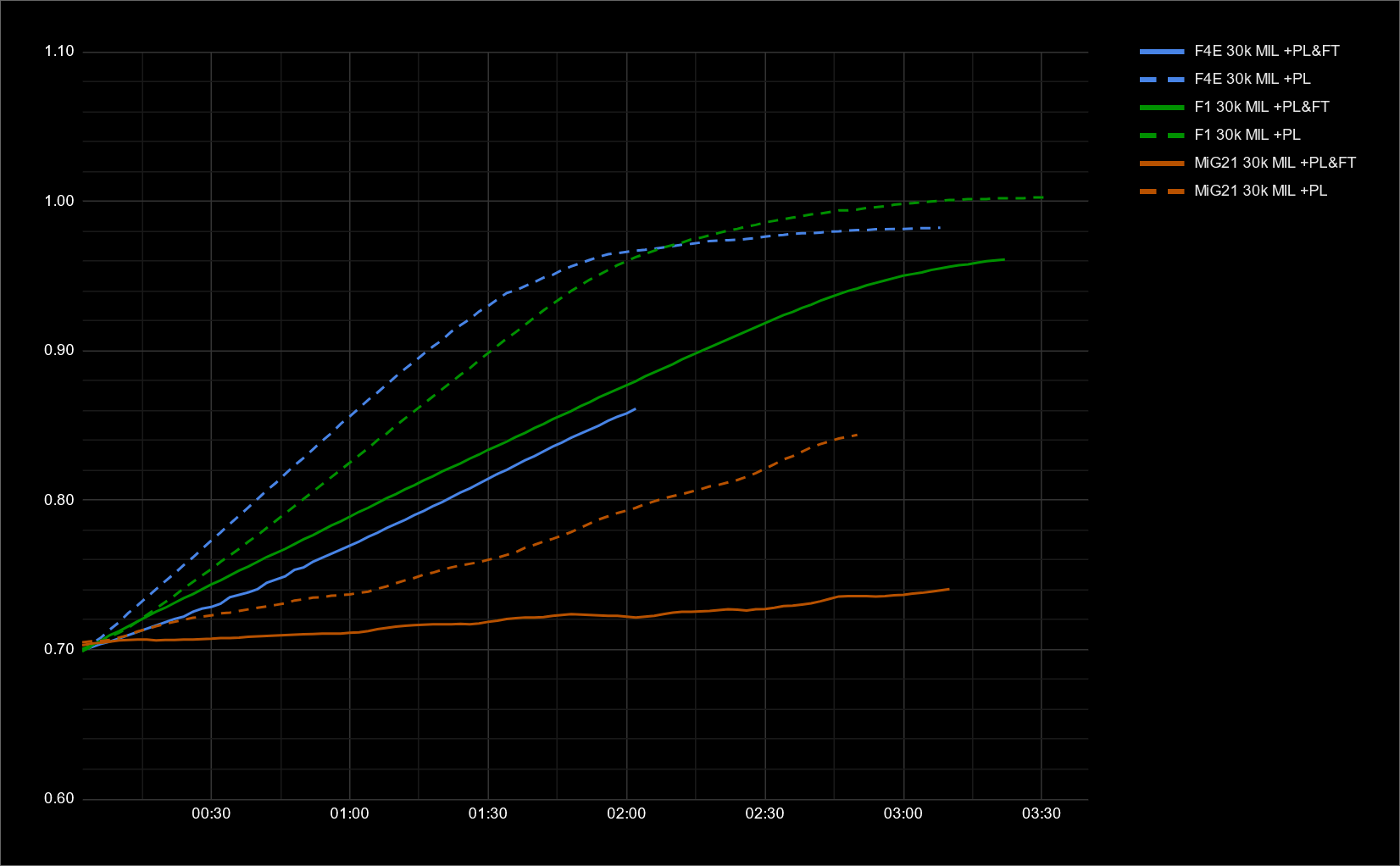
The “clean” configuration shows that the MiG-21bis lags behind the F-4 and the F1 by a considerable margin. The Fishbed’s acceleration is poor, and the Soviet aeroplane does not seem capable of crossing the transonic region, not in any reasonable amount of time, that is. The Mirage F1 instead easily passes Mach 1. It then settles just above this threshold at M1.02. Is this considered supercruise? Perhaps, but we can argue for days about the utility of a clean fighter relying only on very limited internal fuel. On the other hand, the Phantom flexes its muscles by showing slightly better acceleration characteristics and, more interestingly, continuous acceleration throughout the envelope. Albeit minimal, in fact, the F-4 manages to maintain the trend and, at the end of the test, it reaches M1.08.
Payload & Fuel Tanks
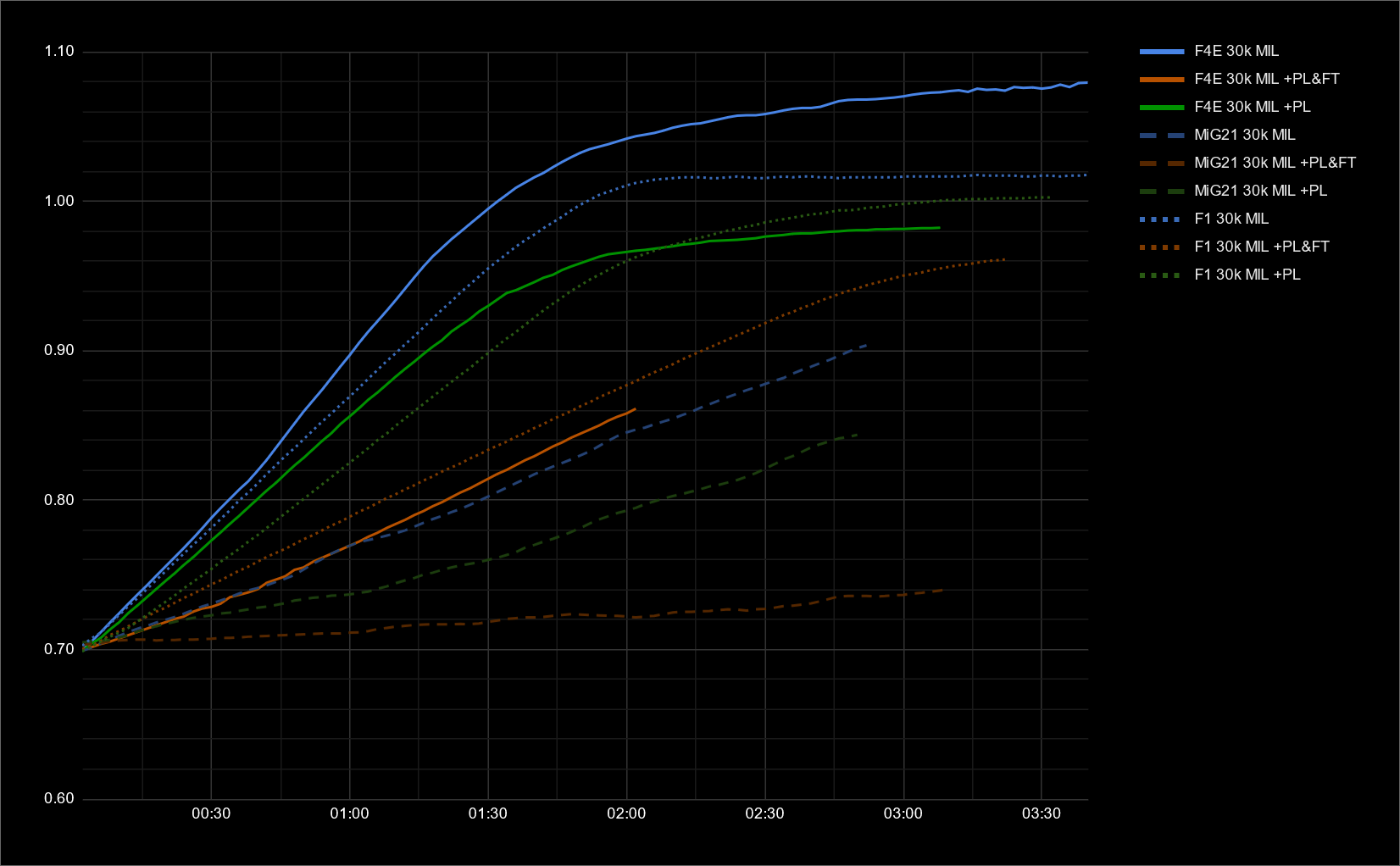
The results are interesting when external ordnance is applied to the three fighter jets. The heaviest load-outs, featuring air-to-air ordnance and fuel tanks, heavily affect their performance. The MiG-21bis almost struggles to keep flying, and throughout the test, it accelerates only by M0.04. The Mirage F1 and its lonely underbelly fuel tank, do not seem too bothered by weight and drag, and maintain a very solid and clean trend, with the acceleration starting to settle at circa M0.95. The Phantom II has been a challenging aeroplane to test in this scenario. Spawned at M.5, I struggled to settle it, possibly due to the low initial speed and the stupidly draggy setup. However, after building up some speed, the F-4 picked up a good pace, closely trailing the French design.
Without the cumbersome fuel tanks, the outcome changes once again. The MiG-21bis still struggles in military thrust setting, but still shows good acceleration. Once again, F1 and F-4E almost go hand-in-hand. At subsonic speeds, the Phanom II shows slightly greater acceleration, but the trend changes close to M.98. Here, the F1 takes the lead, settling at Mach 1. Although beyond the scope of the study, it would be interesting to check if and in what conditions both aeroplanes can supercruise, and with what combination of external loadout.
Fuel Considerations
Alas, the final part of this article: fuel considerations.
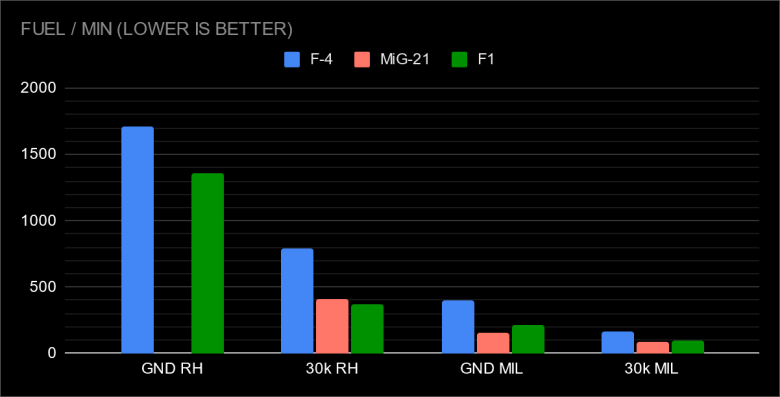
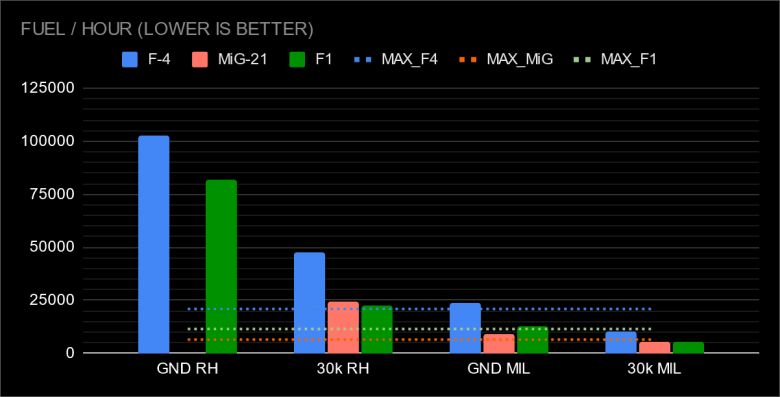
Two observations come immediately:
- Due to the Tumansky R25-300 overspeeding, the Ground + Reheat result lacks data for the MiG-21;
- The Phantom’s pair of J79 is the worst performing of the batch. The primary reason coming to mind is, simply put, the number of engines installed. However, this is not necessarily true, as we will see in the discussion about F-16, JF-17 and F/A-18C.
In addition, the fuel consumption of the single-engined fighter jets is somewhat comparable. However, this aspect does not immediately translate into similar endurance due to the different quantities of fuel carried by each aircraft.
Although the J79s mentioned use more fuel per thrust setting, they often provide better performance. Generally speaking, the Phantom II shows better acceleration, especially at subsonic speeds, and this is a great characteristic useful throughout different phases of an engagement.
 FlyAndWire