

Related Articles
- INS Navigation: “Leap Frog” Operations;
- INS Navigation: Bullseye & Nav References;
- INS Fix Update: TACAN, GCI/Bullseye;
- INS Fix Update: Visual/Radar, GPS.
- What is the INS? Back to Basics – INS, Drift, and Navigation.
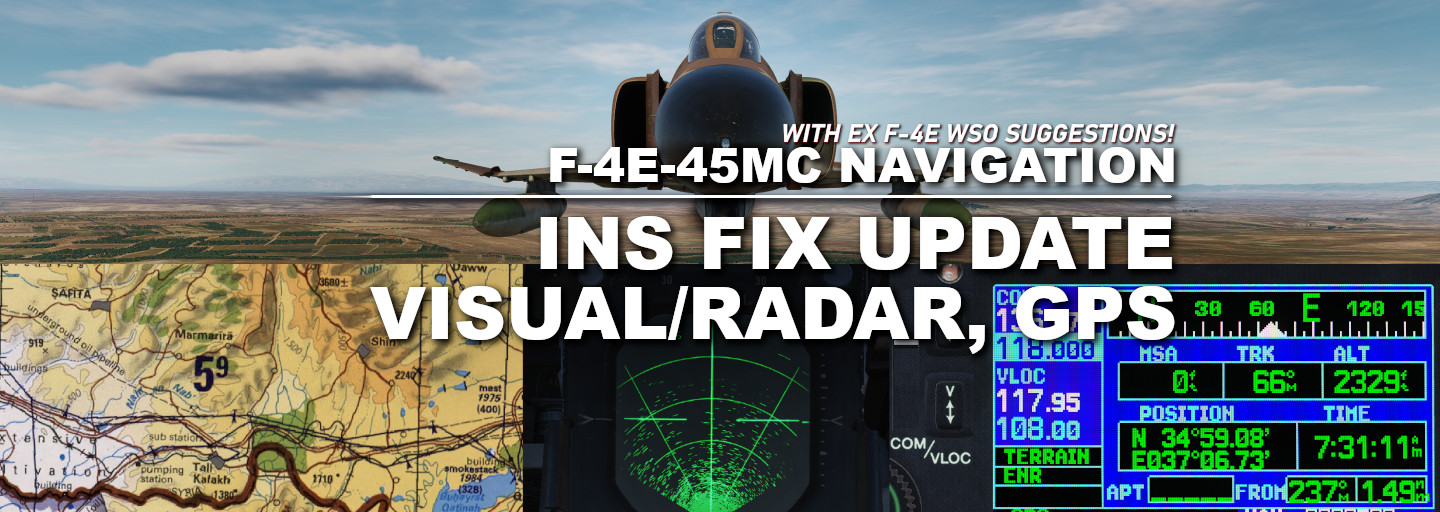
If the TACAN and GCI or Bullseye INS fix update used bearing and range from a known point, the Visual and Radar updates require the Phantom II to fly over a pre-planned position.
The glaring drawback of these techniques is the requirement to fly as precisely as possible over a planned point. This makes the technique potentially very precise, but requires some work beforehand, something that may not suit your type of gameplay.
(and the abilities of your stick-monkey)
Per sé, the technique is straightforward. With the Set/Fix switch in the Set position, the WSO selects the reference point’s latitude and longitude in the position counters. Given the time required for the system to update, hold the switch in the Fix position in advance and until the Phantom is over the designated point. Then, release the switch.
Given the sensibility of the manoeuvre and the perspective as the altitude increases, only low-level visual updates are realistically feasible. This is where the radar comes in. The APQ-120’s ground modes provide the necessary details to, in theory, successfully perform a medium-level update.
The immediate issue with the technique is that some planning is required. The geographical location should be easily recognisable and suitably positioned.
A WSO’s Perspective
I asked “Vulture”, brilliant ex F-4E WSO and Heatblur SME, about the just mentioned INS fix updates.
“As far as INS updates, practically the only tactically useful method was a visual overfly update from low altitude. If you could find a really good radar fix point (usually a land/water feature) you could get an OK update from medium altitudes, but IRL I never needed to do one or bothered – if you did a good visual update at the start of your low level, you were usually close enough for the rest of the flight; the INS just was not the primary means of navigation.”“Until the ARN-101 came along with its LORAN – integrated INS system, you always used basic time-distance-heading navigation and only backed it up with the INS. That being said, it was normal procedure to plan for an overfly visual update at the beginning of a low level route, and plan the start LL point accordingly. After that, it was way too risky to mess with the INS during the actual low level or worse in the IP area”.
So, in real life, navigation back then was still mostly planned and executed with a compass, maps, and a chronometer. This is where reality and game diverge, as players interested in this sort of gameplay are a niche within the niche. Since most rely on the INS for navigation, ensuring the drift is kept under control and the fix is updated becomes vastly more important than for more simulative players or even real life!
GPS Update
This method requires some background. Back in 2019, as I started looking into the F-14 Tomcat’s AN/ASN-92, I wondered whether the GPS-equipped LANTIRN pod could have been used to update the fix position. Then I remembered I bought the NS430 a few years prior, and, surprise, surprise, it solved the INS drift issue like a charm. When I talked about it, the reception was skeptical at best, although Tomcat crews used portable GPS devices in real life.
Fast-forward to the current anno domini 2025, and I am once again proposing the same idea. This time, it sounds a bit less awkward than years ago.
This is the experience of Mike “Starbaby” Pietrucha (F-4E, F-4G, F-15SE WSO/EWO) with portable GPS and F-4G (Timestamp: ~26 mins).
Ten Percent True is a fantastic YouTube channel and podcast well worth following, hosted by Steve Davies. Steve is also an accomplished author, having written books such as “Red Eagles: America’s Secret MiGs.”
More information in the Ten Percent True website.
Vindicated at last! Jokes aside, thanks to Starbaby, the Ten Percent True podcast favourite storyteller, we can see the idea of copying the coordinates from the NS430 into the Nav computer as a bit less odd. As Starbaby mentioned, such a procedure was not necessarily needed for the ARN-101, but it may come in handy in case our F-4E-45MC is used in modern settings.
Since the AN/ASN-46A Nav Computer lacks a “freeze” function, we must try to nail the timing as precisely as possible. The delay caused by the inertial position set update rate of circa 3 minutes per second, both on latitude and longitude, should also be taken into account. Worst case, we can repeat the procedure again to iron out minor discrepancies. This is the advantage of playing a videogame, I guess!

Alternatively, the NS430 can be used to enhance the precision of a visual or radar INS fix update. From the GPS, the crew can extract the position of a specific point, any point, and use the moving map to perform a very precise update no matter the altitude or the weather conditions.
For example, both pilot and WSO can set a waypoint in the NS 430. As the WSO selects the location latitude and longitude into the Nav Computer and holds the position update switch in the Fix position, the pilot can approach the defined waypoint. Once over it, the WSO releases the spring-loaded switch, and the update is complete.
 FlyAndWire
The AN/ASN46 was the analog manual input part of the F-4C/D/E & RF-4C Inertial Navigation System. The Inertial Navigation System had the same Inertial Mesurrement Unit (platform) and analog computer in all systems. Never worked on the F-4C. RF-4C was AN/ASN46 plus AN/ASN56. F-4D was AN/ASN46 plus AN/ASN63. The RF-4C had 1 additional box (Recon Adapter Unit) and a different OSDU (Output Signal Distribution Unit). The F-4D had the AN/ASN46 plus the AN/ASN63 and a different OSDU. The F-4C had the AN/ASN46 plus AN/ASN48 same basic Inertial Navigation System with a different OSDU. Never worked on the ARN-101.
LikeLike