
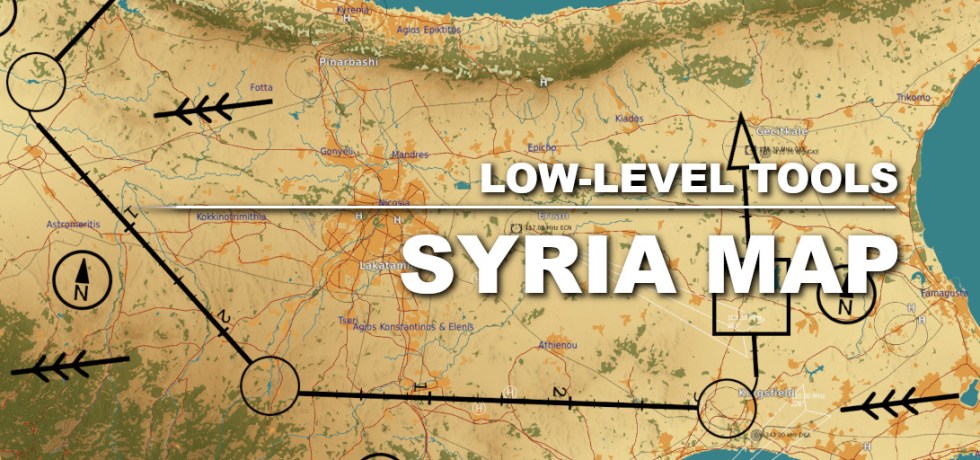
Low-Level Tools: Syria Map
I recently applied for a group that uses the Syria map. Their initial checkride includes an A/G part, so I decided to update my low-level and navigation tools to support this scenario.
I recently applied for a group that uses the Syria map. Their initial checkride includes an A/G part, so I decided to update my low-level and navigation tools to support this scenario.
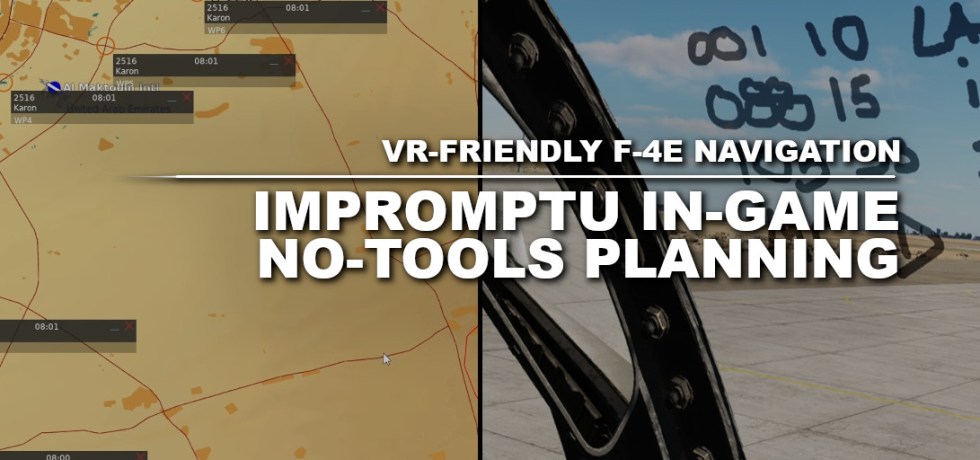
The idea behind this video came from a post I read on ED’s forum about having an in-game F-4E kneeboard page that does pretty much everything (from course and distance to time and fuel). An idea I found very much not feasible.
However, with a bit of the usual ingenuity and the very same rule of thumbs we apply in-cockpit, we can definitely plan something basic in just a few minutes. A more complex solution definitely requires something ad hoc; something that should come from ED itself, and should be fully integrated in DCS.
The “One-In-60” rule is a simple and common technique used to assess and correct track issues. Similar principles can be used to perform impromptu deviations from the planned track.
Time is a fundamental parameter of both mission planning and execution. Sometimes, however, things do not go as planned, and learning how to catch up is critical.
The discussed techniques include dogleg, trombone, speed management and other considerations.
A huge thank you to Vulture (F-4E WSO) and Gaby (AdA Alphajet/Mirage 2000 pilot) for their valuable input!
Wind is critical to planning accurate speed and course. However, wind can change, or external factors can cause the aeroplane to divert. This video shows how the “clock method” can rapidly approximate wind effects.
We have the tools and a general idea of what low-level operation entails, as well as dead reckoning and pilotage. It’s time to put them into practice.
 FlyAndWire