
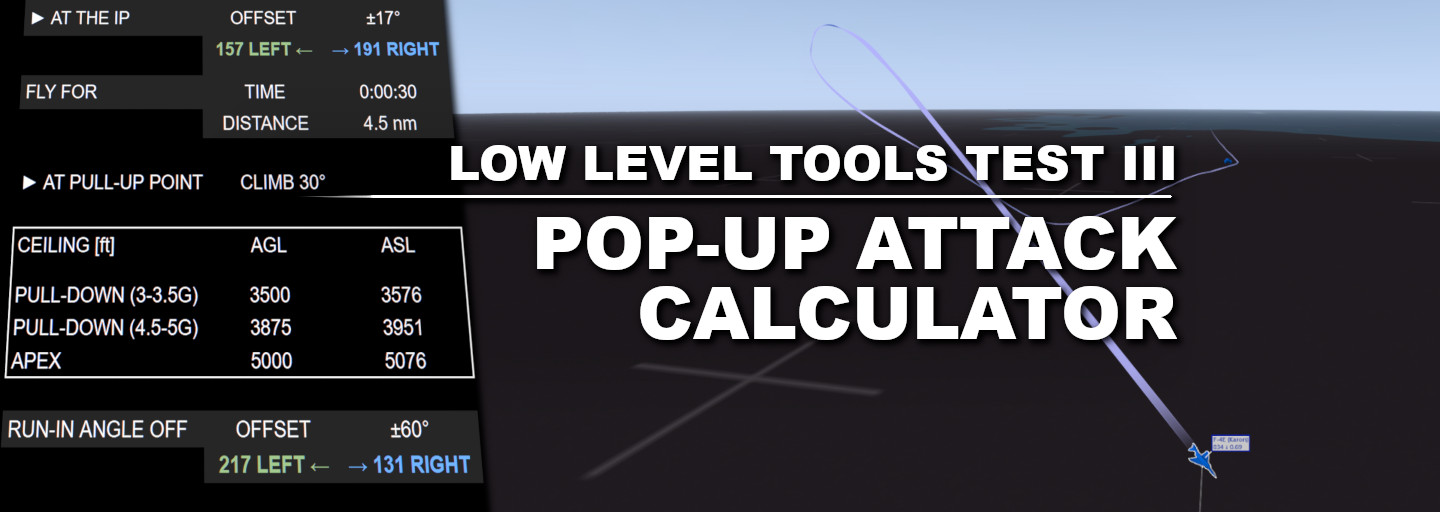

The last addition to my low-level tools is the Pop-up calculator. This manoeuvre, which I briefly introduced only in my book/manual, consists of a more or less steep climb, usually with a lateral offset. The manoeuvre simplifies achieving objectives, such as spotting the target and placing the fighter in a suitable position for dropping its ordnance.
The data provided by the Pop-up calculator is based on rules of thumb and approximations, but I think players not used to such a technique might find it helpful. Myself in primis. The necessary parameters to calculate the result are limited, and many may come from the planning itself. For instance, the TAS or the target elevation.
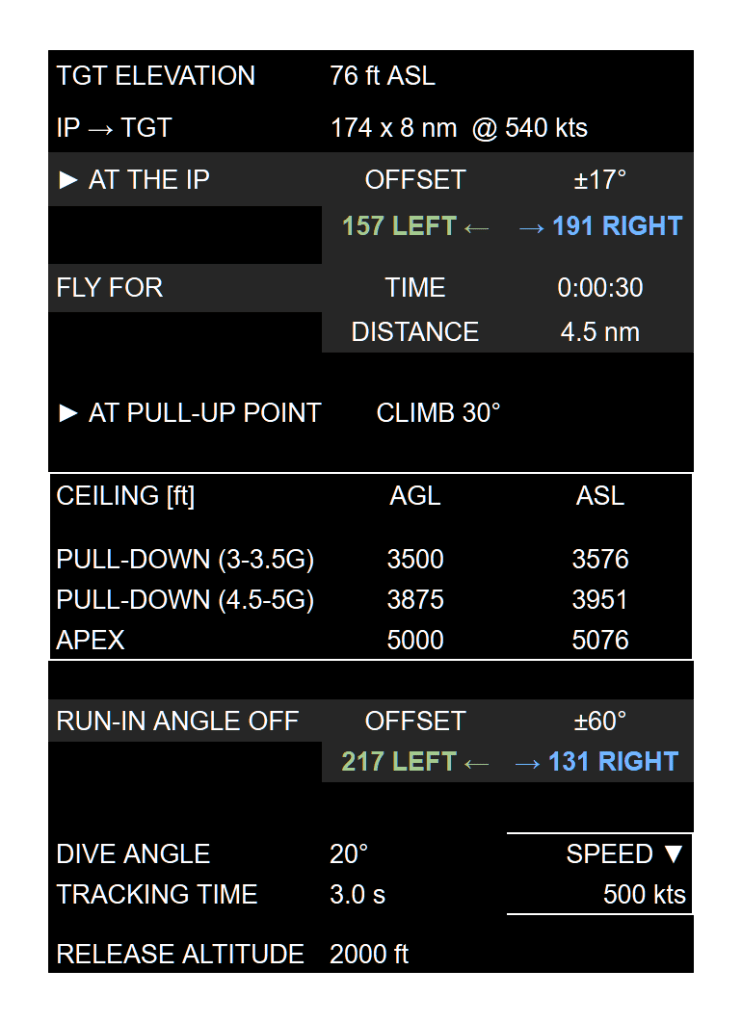
I organised the calculated parameters in chronological order, starting with the leg information, action to take at the IP, pull-up, altitude at which the climb stops, angle off and dive angle. As for the previous tests, this set of data is too packed, but this helps “debug”, test and refresh the briefed attack parameters.
Example
To test the pop-up calculator, I made a straightforward mission: an F-4E spawns at low altitude and on-speed towards two reference points, each identified by a TV antenna and a vehicle. The first antenna serves as the IP mark, the second as the target. The vehicles serve to immediately identify those positions later in TacView.
The initial heading is 174, speed 540 kts.
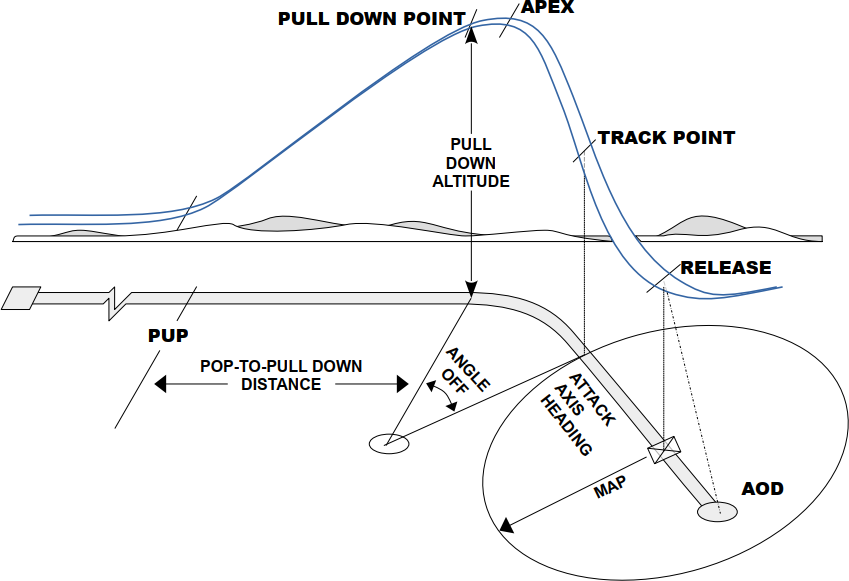
Once the initial point is reached, the suggested offset is 17° in either direction. The offset heading is then followed for 30 seconds, or circa 4.5 nm at constant speed. At the end of such an interval, the Phantom II should be at the pull-up point, where a 30° climb is initiated. The ball is now in the altimeter’s court. Depending on the briefed execution, 3500 or 4000 ft serves as a reference to begin the pull-down, followed by a turn towards the target. The direction change is expressed by the Run-In Angle Off value: 60°.
At this point, the target should be close to the fighter’s nose, and the crew can proceed according to the pre-briefed delivery method.
The video linked above shows the action in-game, with the usual caveat that a toddler busy eating a banana is a better pilot than I, and this is only the second time I tried anything similar. To make “debugging” easier, I activated the control references and the info bar, although I avoided looking at it whilst flying.
The approach to the IP was almost as planned. At Mil power, the Phantom maintains a speed closed to the desired 540 kts, with 3-4 missiles, ECM, a dozen Mk-82s and two fuel tanks. The heading looked slightly off the planned value, and reviewing the action confirms the in-cockpit impression. I added 4-5° to the planned offset. I suppose it is better to gain a couple of degrees more than fewer in this scenario.
After 30 seconds, I pulled up to 30° and held it until the altitude approached the ceiling. At this point, I turned towards the planned heading adjusted for the angle off, and dived. Depending on the briefed delivery method, the crew can now opt for a direct delivery, dive-toss, et cetera.
Tacview allows to appreciate the action from multiple angles.

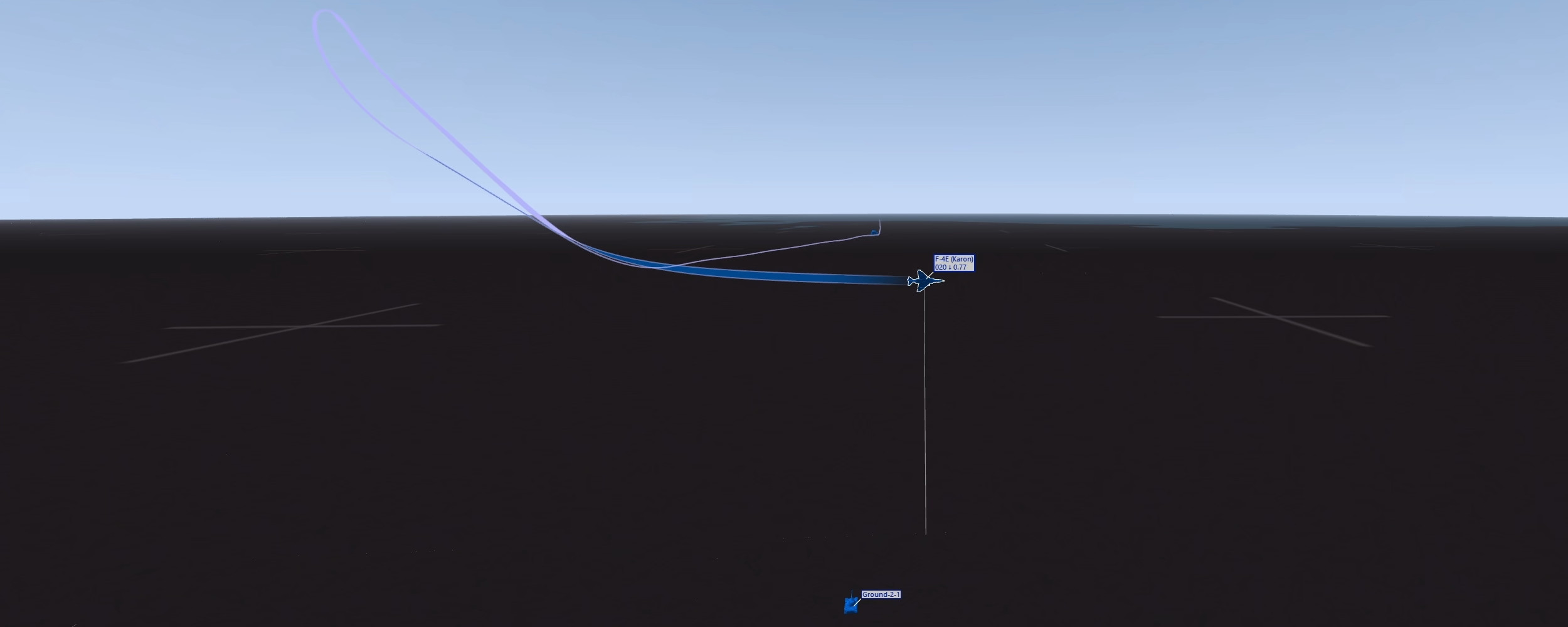
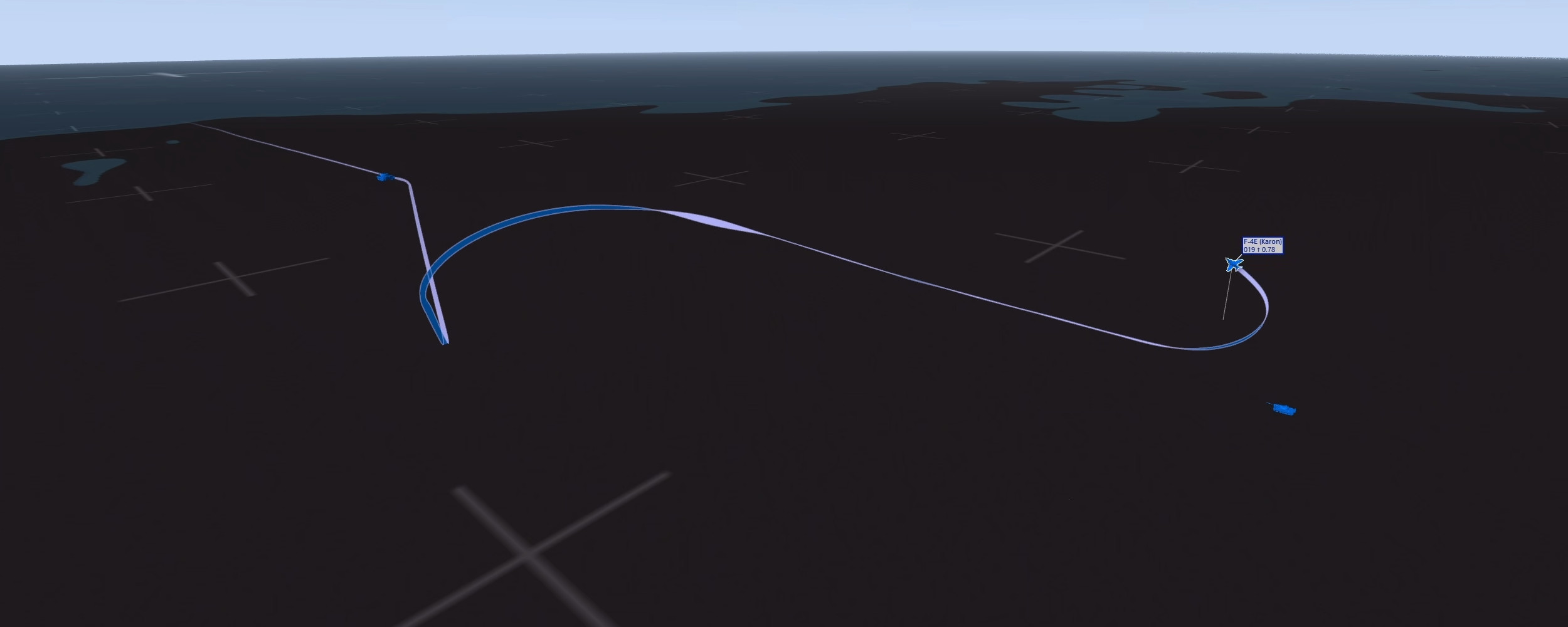
The offset was a couple of degrees wider than I wanted, but it is hard to be precise when dashing at such a high speed and low altitude. A human WSO can definitely help, but overfixating on the precision is counterproductive.
As I approached 3000 ft, I started to ease off the climb. Here I wondered what the best way to do it would have been, and I pulled and rolled to satisfy the planned angle off. Little did I know that this was not a great idea as I zoomed through the expected apex due to the absurd climb rate. Still, after turning towards the expected heading, I saw the target very close to the expected position, which makes the following step of diving and dropping bombs much simpler.
Considerations
The first time I attempted this manoeuvre, I maintained Mil thrust, which resulted in a sluggish turn at the apex, with a speed around 300-350 kts. Being slow makes things easier, as events happen at a slower pace, but the risk is exposing the fighter for longer than necessary. Moreover, the adage “speed is life” very much applies here.
The mentioned fast pace is something I did not expect, especially in the climb. Despite having fuel and bombs, the Phantom zoomed towards the heavens at an impressive pace, and by the time I reacted to the altimeter, I was behind the pull-down point. Rookie mistake.
The pull-down manoeuvre leads to interesting discussions about the best execution of this step, along with the subsequent turn following the angle-off. In my example, I reversed into the target, but this may not be the best modus operandi.
Lastly, the dive was okay-ish. I did not realise in the cockpit, but I was slightly faster. Here, we can clearly see how a rudimentary delivery method, such as Direct, can easily go wrong. Any minor imprecision quickly adds up, eventually leading to a botched release.
Conclusion
The low-level planning tool provides the basic means of creating a flightplan and pop-up delivery. It computes automatically the vast majority of the parameters, and the user can then use whatever they prefer.
I need to improve the interface of the spreadsheet a bit, and then I will release it. At that point, the journey into the neverending rabbit hole of “how things are done properly-ish” will begin.
 FlyAndWire
Hi, Very interesting. I fly with a UK DCS group that used a very similar attack profile but with 6 jets. This was based on one of our members experiences as a Buccaneer Nav with the RAF and was used for attacking ships. Flying in battle formation we split at 15nm to target. We split and climbed with a 10 degree offset, so if flying an initial heading of 000, leader would turn port to 350, 3 would turn to 340 and 5 would turn to 330, 2,4,6, would do the same to Starboard. We would fly that heading for exactly 40 seconds and then turn back to the target and loft the bombs in. It’s very important with 6 aircraft to have a recovery profile, we recovered on a heading of 180, 3 on 200, 5 on 220. I believe this was called an Alpha 3 profile. It wasn’t designed to be really accurate, however the large amount of bombs detonating around the ship was meant to send it offline through concussion. It looked fantastic on Tacview. I’d be happy to send you kneeboards and info. CheersAndrew
LikeLike
Nice, what is your group called? I was looking for one UK-based, but the ones I know (e.g. JSW) have conflicting schedules.
Ref the Bucc, it’s a crime it is not in DCS already! I have some sketches of attack planes around (Sierra 1, Delta 1, Echo 1), and I may add some of them to the calculator at some point.
So far, I have based my calculator on the F-4E, but it is incomplete (e.g., I have not looked into how to approximate the MAP properly yet sine tracking distance). It is a rather simple offset that works with or without a split. My goal is to integrate it into the planner and expand it in the future.
I’d be curious to check how you guys do things. Add me up on Discord, if you want. Thanks!
LikeLike
Hi, I Fly with 41f, we’re part of RAF AIR. It was set up by a couple RAF chaps, Wing Commander Bill Pixton and Ade Rhoney, an armourer. They both fly regularly.
We’re influenced by Will’s wartime experience and all of his cold war training too. Will thought, what flying did he enjoy the most, and that’s what we fly. Mostly offset card, below 200ft and at 420kts. It’s great fun in multiplayer.
With the group set up several years ago, we use the F18, so it’s not exactly true to life, however some of the systems were available in the Jaguar so we sort of bodge it.
We have a great training programme, which I help with.
We fly Most nights, but the main group night is Tuesday, with the brief at 19.30, and we’re usually debriefed by 21.30.
If you fancy it I’ll send you an invite to our discord, you sign up there, here’s the website link, and I think there is a link to discord there.
https://www.rafairuk-dcs.co.uk/base_info.php?id=24003
Cheers Andrew
LikeLike
Thanks mate, the schedule would be a bit tough to meet. For instance, my last proper mission was 5 years ago for this very reason.
I hopped in your Discord, see you there!
LikeLike