
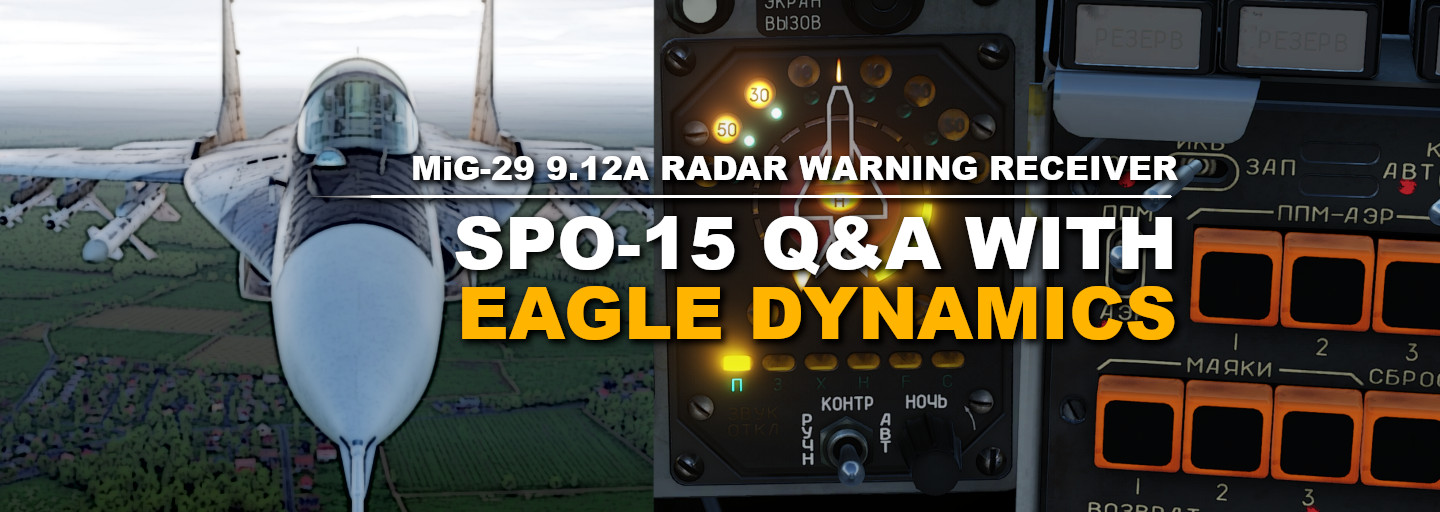

The SPO-15LM is an improvement over the brand-new technology created for the Mi-24’s RWR, the SPO-10. Compared to the modules sporting the same devices in Flaming Cliff, the promised improvement is enormous. So, I decided to dive a bit deeper and collected a few questions to better understand what we will soon-ish find in the brand new MiG-29 9.12A and submitted them to Eagle Dynamics. Today, I got some answers.
Before starting, a big thank you to ED for spending time in this surely busy period to provide more information. Needless to say, the answers are reported as I received them.
Question I
The first question is from yours truly. In one of the initial news, it was stated that the SPO-15 would have adapted itself depending on the scenario and threats.
“A question popped into my comments: why does the SPO-15 auto-adapt to the mission, rather than leaving the choice to the mission designers? For instance, if you want to replicate something like Kosovo, the SPO-15 may not be able to react to the 120B. According to the books I read, the first MiG-29s were shot down without even realising they had incoming missiles. However, if you force it, this cannot be replicated. Couldn’t a simple checkbox be set in the ME prior to the functions that recreate the threat list?
(Book example: “Laslie, Brian D. Operation Allied Force 1999: NATO’s airpower victory in Kosovo.”)“.
Answer
The SPO-15 will come with 2 options, selectable in special options tab for each aircraft in Mission Editor: stock and automatic. The stock setting is intended for former Warsaw Pact aircraft and includes a fixed program that matches the period when the MiG-29s were first delivered – this DB does not include most threats present in DCS, however that does NOT mean these threats will not be detected – the SPO-15 will detect any radar within its operational band and will always report a detection even if it doesn’t recognize it. In other aircraft that use SPO-15 these unknown sources can be filtered out, but in the MiG-29 this option is not available due to lack of full control panel for SPO-15.
The automatic threat program is built on top of the stock program (overwriting PW/PRF bins of the stock program as needed) to match enemy threats within the mission. This however does NOT include missiles, for a simple reason: the SPO-15 doesn’t have the resolving capability to distinguish ARH missiles from aircraft that carry them – therefore as long as the carrier aircraft is listed in the threat program (and it typically will be, as the entire HPRF range is filled in as type F by default as are some MPRF slots), the incoming ARH will be mis-identified as the carrier aircraft.
As for the case described in the book: this will always be the case, because the transmitters in older ARH missiles are typically quite weak (as the seeker is used for terminal guidance), and the SPO-15 is not sensitive enough to give advanced warning – typically the missile will only be detected 2-4s before impact depending on angle of arrival. And even then, it will not trigger a launch warning (in fact there’s no possible scenario in DCS that would trigger the launch warning in the MiG-29 currently), which means that in many scenarios it will be completely unnoticed, particularly if the aircraft is already locked on to by a higher priority threat than type F.
As for manual database, it is something that we have considered and that might be considered later in EA if there’s a demand for it – currently it doesn’t fit any other workflow, as the threat programs are something that would be consistent per country, per theatre, and would not be customized on per-aircraft basis nor by the pilots, as they weren’t possible to update in field – the threat program cartridge (which contained a hardware implementation of both the database and the threat recognition algorithm) had to be sent back to manufacturer to update. For that reason it does not fit into the new DTC functionality.
Question II
Question asked by Brody Zachary.
“[ED] mentioned side-lobe bleed causing threats to register in the wrong bearing sector (flank/sides/rear). Are there cues that help pilots tell these apart from real emissions, like flickering, strength fluctuation, sector drift, etc?”
Answer
Generally no. The indicator in the SPO-15 does not show raw signals, it shows fully processed (including recognition and priority check) detection events. It also does this separately for each sector, going through them in clockwise fashion one at a time and repeating the whole process for every sector separately. One cue that the pilot might get is if the threat is selected as priority – in that case the weaker signals from other sectors might be considered lower priority by the system due to their lower signal power, and thus they will not be marked as priority despite arriving at the same time from the same threat type. But even in that case there isn’t really any way to discern that from an actual detection of another threat of the same type, but further away.
As for signal strength indicator – it can provide clues as to whether the pilot is the intended target of the hostile system or not – if the strength is lower than expected, or if it goes up rapidly followed by a priority threat being dumped and returning with a lower signal power: all of that might indicate the hostile radar is actually locked onto another aircraft.
Question III
Another asked by Brody Zachary.
“With [ED’s ]implementation, is it common for threats to briefly vanish or hop between bearing sectors? How should pilots interpret that behavior if so?”
Answer
A few technical details need to be explained to address this question: First of all, each detection event is remembered for only 0.125-0.25s – that’s how long the green light will flash for. The priority threat, as well as any detected type (type memory is separate from sector detection events memory with no association between a threat and the sector it was detected in) is remembered for 2-12s after that depending on emitter mode, scan rate, and which point in memory dump cycle it was picked up at. This threat memory is per sector, with again each sector treated as a separate “sub-RWR”, even for the priority threat: the way a priority threat is tracked between sectors is by overwriting the priority threat memory if an equal or higher priority threat is detected and then extinguishing priority azimuth lights in sectors that do not have an ongoing detection event.
Secondly, the azimuthal resolution of the SPO-15 is really poor – in best case scenario it’s 10 degrees, but this is only within the +/-50 degree range, for higher AOA it will grow way above that.
Thirdly, as this is likely the intent behind this question: no, the physical mechanisms behind fluctuation in measured AoA of western RWRs (a hot topic within the community) is not presently modelled for the SPO-15, as it is not a factor due to how poor the resolution is to begin with – such fluctuations are much lower in magnitude than the angular resolution of this device. The SPO-15 does not measure the AoA of the signal continuously like modern RWRs do, each sector is handled separately and will either detect the threat or not – with the result presented on the corresponding section of the indicator for that sector only.
To answer the question: in the case of one receiver and one emitter with the receiving aircraft flying in a straight line, jumping between sectors will not be very common. Vanishing and reappearance will also not be common for incoming threats, but it might occur every scan cycle for outgoing threats (because their priority is decreasing) or for emitters that are powerful enough/have low enough scan rate to falsely trigger a lock on warning.
For multiple threats, the primary threat might sometimes rapidly jump between sectors – in those cases, the pilot should assume they are dealing with multiple threats of the same type, especially if they’re separated in azimuth by more than 20 degrees.
Question IV
The last question from Brody.
“[ED] described the SPO‑15 displays signal strength in 2 dB steps, but is this based on absolute ERP received at the antenna, or is it normalized relative to the strongest signal present at the time? Can the same emitter show different power levels depending on what else is emitting nearby?”
Answer
It is based on absolute ERP, however the measurement range differs between CW and pulse signals by a factor of 18dB (the circuits for signal power measurement are separate for CW and pulse signals). The dynamic range of the device is only 30dB and the indicator spans that range. The indicated power will typically be consistent with range if the receiving aircraft stays close to boresight, otherwise it might vary considerably, as the radiation pattern of the emitter is taken into account.
Question V
Question asked by Aeria Gloria.
“Will the 90 light not only light up only with 50 light, but 90 light only light up at close range? Long range only 50 light turns on if radar is at 90 degrees. This is because the 90 light needs the less sensitive rear antenna to work”
Answer
Yes, the 90 degree “sector” is much weaker, not just because of lower sensitivity of rear hemisphere (AND sector 1 and 8 – in fact amplifier gain is adjusted so that these sectors are triggered at the same power density as rear sectors, about 3dB above the forward hemisphere threshold) but also because of how far off-boresight for both antennas the signal needs to be in order to be detected by both simultaneously. In fact the 90 degree sector being triggered at all is going to be fairly uncommon.
Question VI
The last question submitted to ED, asked again by Aeria Gloria.
“Are PD fighters in Hawk category until around 15-20 km where they are then put in F category?”
Answer
Yes, however the range is much wider than 15-20km and will vary depending on emitter power, anywhere from merge range to ~50km out (e.g F-14). It also only applies to H/MPRF radars and modes.
Conclusions
And that’s if for this set of questions and answers. To wrap this up, I want to highlight two points.
In primis, I am extremely impressed by the depth of the new SPO-15. From the 2-mode programmability to the sensitivity depending on angles and threats, the complexity of this system is honestly mind-blowing.
The F-4E’s ALR-46 gave players a first taste of the capabilities of older devices, immediately changing how virtual crews build their situational awareness. This aspect will be even more important for the MiG-29 9.12A. But the Fulcrum can take advantage of a hidden trick: datalink-guided intercept information, something I suspect the whole community is very curious about. Along to that, the next aspect of DCS I’m looking forward to seeing overhauled: Ground and Airborne Intercept Controllers.
Next, I’d like to acknowledge the steps Eagle Dynamics has taken to improve their communication. And no, I am not referring to this Q&A. Instead, I am talking about the videos made by Wags in January and February (Q&A) and the August patch. I understand this won’t be always possible, but augmenting the monthly “big patch” with a video highlights even better the effort put by the team. August’s video, for example, sits at almost 50,000 views with an upvote ratio of 98%, a sign that the community clearly liked it.
On top of that, another addition, albeit less visible: the new Discord channel, appropriately called “DCS development highlights”. Every few days, and sometimes every day, a glance into the new features, fixes, and updates is posted there. This allows the community to follow the development, have an idea of the new upcoming features and how the work is progressing.
 FlyAndWire
Aeria Gloria: Thank you so much. If you are able, I have two other short questions of high importance
Thank you very much. I believe I didn’t tell you these questions before because I did not believe that ED would model it with your own radar interfering with it or not detecting a Sparrow launch. However recently I have come to realize these things are far from assured.
If possible to ask these questions, I will be even further in your debt!
LikeLike
Hey, sorry, I missed your comment. I have a long batch of questions waiting to be answered. I’ll wait to get those before submitting more 🙂
LikeLike