

The previous article showcased the anti-aircraft artillery units present in DCS. Although initially, I meant to stop there, I decided to add MANPADS and SHORAD. The first funny word stands for Man-Portable Air-Defence System. If you are unfamiliar, imagine infrared-guided RPG-like weapons that home on the hot exhausts of aircraft flying nearby. The second funny word stands for Short-Range Air Defence. I decided to use this term as an umbrella to include Self-propelled AAA and Short-range Surface-to-Air Missiles.
The test setup is still the same, and the unit located in the centre of the semi-circle retains the higher AI skill level.
SPAAA Gepard
The Flakpanzer Gepard is a Cold War relic, currently living a second youth on the Ukrainian front lines.
This unit sports two 35 mm autocannons that bring devastating effects on any target. Worst still, for the target, that is, the Gepard has its own radar, drastically increasing its spotting and tracking capabilities. This, plus its calibre, allows the Gepard to be a threat at considerable distances.
In DCS, the Gepard is absurd: I was honestly stunned by its precision and firepower. In my opinion, it is the scariest SPAAA in the game.

SPAAA Vulcan M163
The Vulcan M163 is a 20 mm rotary cannon strapped to the chassis of an M113. The gun is a variant of the M61 used by most US aircraft, and it’s a familiar weapon.
In-game, its performance is poor. It lacks the tracking capability of the Gepard or the Shilka, and the result is a cool-sounding spray-and-pray machine, limited to good-weather operations. Still, if it hits, you definitely feel it: the volume of lead coming towards the target is not a joke.

SPAAA ZSU-23-4 Shilka “Gun Dish”
The Shilka is one of the most iconic and recognisable air defence systems, both in-game and in popular culture, perhaps due to its radar or the set of four barrels.
In DCS, the Shilka bears a resemblance to the Gepard, but there are several notable differences. In primis, the calibre is smaller, 23 mm versus 35 mm, thus reducing the effective range. On the other hand, the volume of fire is even more considerable. No pilot wants to fly close to this monster on tracks.

SPAAA ZSU-57-2
The previous discussion highlighted how the S-60 57 mm was a capable gun. So, one day, the Soviet engineers woke up and decided to toss two of them into a T-54’s chassis. The result is the ZSU-57-2.
The twin S-68 guns, derived as mentioned from the S-60, generate a considerable amount of firepower for the era. The 57 mm projectile does absurd damage to everything it touches. However, the lack of any modern searching and tracking device reduces the accuracy of this unit.

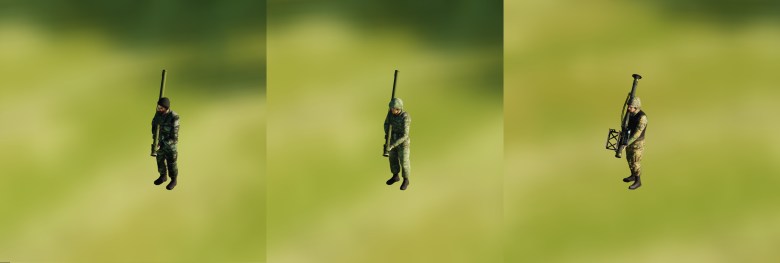
MANPADS: SA-18, SA-18-S, Stinger
Due to their similarities, I decided to group the SA-18, the SA-18-S, and Stinger in a single segment.
In terms of performance, in fact, this test is too brief to pinpoint any meaningful difference between the three. All of them were unreliable against the low-flying fast jet, partially due to the complex conditions, and partially for another reason.
So, do you remember that I mentioned earlier how MANPADS and SHORADs were not meant to be included in this showcase? Well, you will see why going forward, namely because the AI decided a few times that launching an IR missile right as targets flew in front of the sun was a good idea. As many of you have already guessed, the result is that missiles went straight for the big and slightly warm nuclear-fusion-powered ball in the sky, rather than the target.
Although I initially contemplated the idea of changing the mission, it then dawned on me how this was actually useful. I haven’t looked at how IR missiles and countermeasures work since 2019, and it appears that the AI still cannot manage certain environmental conditions, such as clouds or, such as in this case, the presence of the sun. So, since the AI launches anyway, good firing solution or not, the good old pre-emptive flare release seems to be still a good idea. This is a point worth investigating.
SAM Chaparral M48
Let’s now look at the short-range surface-to-air missiles (SHSAM? SRSAM? SHRSAM??), starting with the M48 Chaparral, named after a plant, a shrubland plant to be precise. Its appearance is as curious as its name.
The M48 fires a derivative of the familiar AIM-9 Sidewinder infrared-guided missile. A solid weapon, but subject to the same pros and cons as other systems based on the same technology.
In-game, the Chaparral has the curious characteristic of repositioning itself before firing, and it is reasonably effective against most targets flying at low altitude.

SAM Linebacker – Bradley M6
The M6 is a Bradley infantry fighting vehicle whose TOW launcher was replaced by a pack of four Stingers. Therefore, there is not a lot to say about that, besides the fact that I expected it to use its cannon against the rotary-wing target, something it did not do.

SAM Rapier
The Rapier is a peculiar system composed of multiple parts. The launchers hold four ready-to-launch missiles each or more, depending on the variant.
The Rapier uses an optical tracker for guidance, and the radio-guided missile is smokeless. Therefore, the targeted aircraft has little warning and time to react after being engaged.
In-game, launchers carry four missiles each, and the Rapier performs well against all targets besides the Apache. Which is curious for a manually aimed system.

SAM Roland ADS
Ah, Roland. Hard to see this name without triggering Torquato Tasso-related high-school PTSD flashbacks… Anyway, similarly to the myths related to Carolus Magnus, aka Charlemagne, King of the Franks, who were a Germanic tribe, this SAM is Franco-German.
The Roland is a capable system, deployed multiple times in real life. In DCS, it is extremely capable against all targets, sans the Apache. Fortunately for its targets, the missile produces a considerable quantity of smoke, thus revealing the battery’s position.

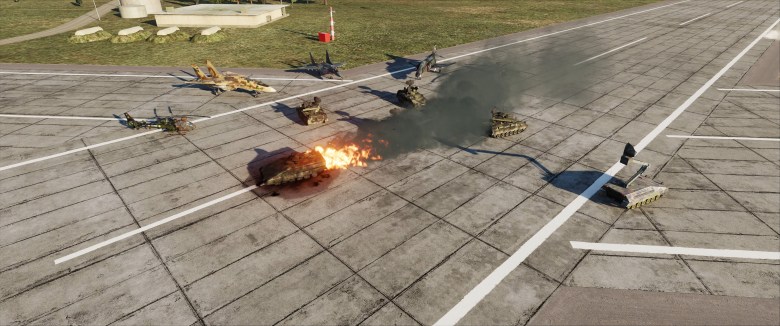
Well, it is indeed a Franco-German system: there have been eight major wars between France and Germany / HRE since the 1700. Twelve, if the Napoleonic Coalition Wars are accounted.
Also, map for the US-based viewers:
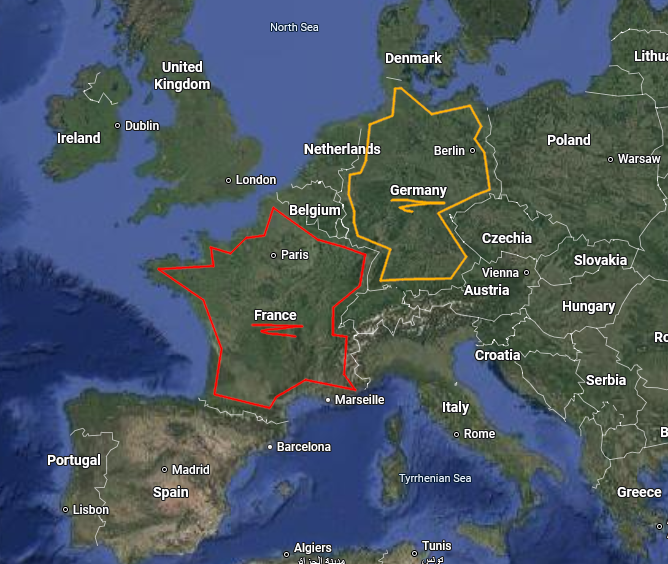
Oh, I’m going to get so much hate for this joke!
SAM SA-13 Strela 10M3 “Gopher”
The mid-70s SA-13 Strela-10 is an upgrade of the initial incarnation of the “Strela” family, the 1960s SA-9 Strela-1. In DCS, this unit has a couple of peculiarities. In primis, it uses its machine gun to engage appropriate targets, something other units do not do, such as the mentioned Bradley M6. Then, it produces a very odd sound before its missiles are launched. I initially thought Discord changed its notifications for the Halloween period!
Performance-wise, the SA-13 is a solid system, although it seems slightly slow to react, and it missed a few times against low-flying targets.

SAM SA-15 Tor “Gauntlet”
The Tor comes in two flavours; this is the basic variant introduced in the late 80s.
There is not a lot to say about this system: although it is ineffective against the Apache, it is terrific against everything else. In particular, it offers an impressive range, making it capable of quickly dealing with a broad range of targets.
The trajectory and the abundance of smoke produced by the Tor make it recognisable at range, which is the only drawback of this surface-to-air system.

SAM SA-15 Tor M2 “Gauntlet” [CH]
The Tor M2 is a late 2000s upgrade of the original system. The variant available in DCS is marked with a “CH” in the name. Therefore, I assumed it was the country code for the Confoederatio Helvetica, but an SA-15 in Switzerland sounds slightly out of place. Then I remembered about the units pack recently integrated into DCS made by CurrentHill, and this Tor M2 is probably one of their units.
Performance-wise, the M2 further improves on the already excellent Tor, shooting more, farther, faster, and even the Apache is not an issue anymore.

SAM SA-8 Osa “Gecko”
The NATO-named “Geko” is an odd short-range air-defence system. Fairly compact, with an integrated radar and quickly redeployable, it is so ugly that only its designers may love it. Like other systems described here, this early-70s product of the Cold War is another veteran of many conflicts.
In DCS, it is a mixed bag. The SA-8 did not react to the low-and-slow AH-64 Apache, and struggled against the low-but-not-slow Tornado. The system proved to be an efficacious solution against the Su-25 and the Antonov, instead.

SAM SA-9 Strela 1 “Gaskin”
If you are wondering why the SA-9 Strela-1 is not before the SA-13 Strela-10, it is because I am following the order you find in the game. I guess that’s what happens when you order strings character by character…
Anyway, in-game, the performance of the SA-9 is good against low-flying targets, but the SA-9 is characterised by having both a short range and a quite slow missile. Nothing too surprising given the age of this air-defence system.

SAM SA-19 Tunguska “Grison”
The Tunguska is one of the best, if not the best, short-range air defence systems in DCS. The combination of dual high-rate-of-fire 30mm cannons, coadjuvated by almost smokeless surface-to-air missiles, makes this 1980s system extremely dangerous. The lack of plumes is a benefit of using a peculiar dual-stage propelling solution.
In-game, the SA-19 is a scary system, especially against aircraft that lack modern radar warning receivers. It appears to lose efficacy against the Antonov flying at 10,000 ft, but it is deadly against everything else.
The vehicle recoils when the cannons open fire. I liked it.

 FlyAndWire
First of all, thank you for the outstanding work …
then, on the shorad point of view, you seem to have forgotten the new “grain of sand” in e the Apache gears … The small and insignificant (being sarcastic here) SA-22 (Pantsir) that decimates anything within 20kms …
regards
LikeLike
Hey mate, thanks.
There are at least a couple of units missing. The Avenger is one, since it was a bit redundant. The Pantsir is another because I found it to be rather pointless in DCS. The Sa-22 is a mid-2010s, falling in a vacuum that makes DCS quite flat. Consider this: if you want to play realistically, that period still falls into the american WoT. Ergo, a very asymmetric conflict. If you want to play without a historical setting, you have 2010+ us modules fighting… 1983 MiG-29 9.12! For this reason I don’t spend time covering units post mid-90s.
LikeLike